
Lalbagh Botanical Garden in Bengaluru is a good place for senior citizens. But it works best when you visit slowly and pick only a few places to see.
The garden is very big. It covers about 240 acres. Some paths are flat and easy. Some are uneven or slope up and down. The good news is that Lalbagh has benches, drinking water points, washrooms and a battery buggy. With these, an elder can enjoy the garden without walking too far.
This guide is for people above 60, and for families planning a trip with their parents or grandparents. It also helps anyone who finds walking hard.
Is Lalbagh a Good Place for Senior Citizens?
Yes, it is. Karnataka Tourism describes the garden as senior-friendly because of its wide paths and buggy service. Many senior citizens in Bengaluru also walk here every morning.
Here is what makes it easy for elders:
- Wide paths where two people can walk side by side
- Benches and seating spots in different parts of the garden
- Shade from very old, tall trees
- Drinking water points and washrooms
- A battery-operated buggy for people who cannot walk far
- Open hours from 6 AM to 7 PM, so you can choose a cool time of day
Here is what can be hard:
- The garden is huge, so the walking adds up fast
- Some walkways are uneven, and elders with knee or joint pain have complained about them in past news reports
- The rocky hill area has steps and rough ground
- Weekends, holidays and flower show days get crowded
So the aim is not to see everything. A calm two-hour visit is far better than a tiring four-hour walk.
What Is It Like to Walk Inside Lalbagh?
Lalbagh is not one flat lawn. It has wide roads, paved paths, grassy areas and a rocky hill.
The main roads and wider paths are the easiest. They are good for walking slowly, for a walking stick and for most walkers.
Other paths are not as smooth. In a survey by Deccan Herald and Prajavani, senior walkers said some walkways were uneven. They also said the unpaved paths near the lake bund turn slushy after rain. Conditions may have improved since then, but it is wise to expect a few rough patches and to walk with care.
The rocky hill is different again. Lalbagh has a very old rock formation, and a watch tower stands on top. Reaching it means climbing over uneven ground. For an elder with weak knees or poor balance, this part is best skipped. Nothing is lost by skipping it. The rest of the garden has plenty to enjoy.
The middle part of the garden is a better base for elders. The famous Glass House is here. It was built in 1889 and its design was inspired by the Crystal Palace in London. The Bonsai Garden is behind it. Lawns and old trees are close by, so you can see a lot without walking far.

Which Gate Should You Use?
Lalbagh has four main gates. They are on the north, south, east and west sides. People call some gates by different names, so tell your driver the road or landmark you are heading to, not just “the main gate.”
Private cars are not allowed to drive inside Lalbagh. The Horticulture Department has kept vehicles out of the garden to keep it a walker-friendly place. So the real question for an elder is how much walking there is between where the car stops and the first place to sit.
A few ideas can help:
- By car: Ask the driver to stop as close to the gate as allowed. Let the elder get down there. Then the driver can go and park.
- By metro: Lalbagh station on the Green Line is very close to the garden. Ask a guard at the station exit which gate is nearest.
- By auto or cab: Choose the gate closest to your starting point. Ask the driver to stop right at the entrance.
- From the Double Road (KH Road) side: This is the east side of the garden. It is a known entrance where vehicles are stopped.
Decide the gate before you leave home. It is much easier than working it out in traffic.

The Battery Buggy: A Big Help for Elders
The battery buggy is the best thing for anyone who cannot walk far. It looks like a small golf cart and carries several passengers at a time. Karnataka Tourism lists electric buggies as a visitor facility. The Horticulture Department has said these vehicles are meant for people who find it hard to walk, such as senior citizens, disabled people and children.
Who runs it? The service has been run by a private company on behalf of the department.
What does it cost? Many visitor guides mention a fare of around ₹100 per person. Fares can change over time, so check the board or ask the staff before you sit.
How long is the ride? Some visitors mention a ride of about 40 to 45 minutes around the main roads of the garden. This gives you a good look at Lalbagh without walking.
Does it reach every corner? No. A buggy can only go where vehicles can move safely. Narrow lanes, steps and the rocky hill are not part of its route.
Will there be a wait? Possibly. In past news reports, regular visitors said there were not enough buggies for the number of people who wanted them. Weekends and holidays are likely to be busier. A weekday morning is a better bet.
Ask about the buggy first, before you walk deep into the garden. It is easier to wait a few minutes near the entrance than to help a tired elder walk back.
Wheelchair, Walker and Walking Stick
Wheelchairs, walkers and walking sticks can all be useful in Lalbagh. But the ground is not the same everywhere.
Easy for wheels and walkers:
- The wide main roads
- Flat, paved paths
- The area around the Glass House
Harder for wheels and walkers:
- Steps and raised edges
- Slopes
- Loose stones, grass and unpaved stretches
- The rocky hill
- Narrow garden lanes
Some visitors say the flatter roads are fine for a wheelchair, but steps and ramps in a few places can be tricky. This is a visitor experience and not an official access map. Ask the staff at the gate which route has the fewest steps.
If the elder uses a walker or stick, keep it with them the whole time. A short path can still be tiring.
Where to Sit and Rest
For an elder, a good bench matters as much as a good view.
Lalbagh has benches and seating spots in different parts of the garden. Karnataka Tourism lists seating areas as a garden facility. Many spots are shaded by large trees.
A simple rhythm works well. Walk for a while, sit, drink some water, and then walk again.
The area near the Glass House is a good resting point because it is central and easy to reach. The lake side is quieter and a nice place to sit and watch birds and water. On busy days, the best benches fill up early. If you find a free shaded bench, use it, and do not wait for a perfect one.
Washrooms and Drinking Water
Karnataka Tourism says there are clean restrooms near the major entrances and drinking water points around the garden.
Toilets are not everywhere in such a big garden. Senior walkers have said in the past that there are too few of them, and that the toilets open at 6 AM even though many elders arrive earlier. So when you enter, look for the nearest washroom and remember where it is. Use one when you see it, before you really need it.
Carry your own water bottle too. It is a helpful backup if a drinking point is far away or not working.
Best Time to Visit Lalbagh with Elders
Lalbagh is open every day from about 6 AM to 7 PM. Karnataka Tourism suggests visiting in the morning and avoiding peak hours.
Early morning is the best time for elders. The air is cooler, the paths are calmer and you can walk at your own speed. Many local senior walkers come at this hour, so the garden feels friendly and lived-in.
Evening can also be pleasant, but the light goes down fast. If the elder walks slowly, leave enough time to reach the gate before dark.
Summer: Skip the middle of the day. Carry water, wear a cap or hat, and stop often in the shade.
Monsoon: Wet paths, fallen leaves and puddles can be slippery. Wear shoes with a good grip and go slowly near slopes and stones.
Winter: This is a comfortable season for a long, gentle visit.
Flower show days: Lalbagh holds its big flower shows around Republic Day in January and Independence Day in August. These days are very crowded, and tickets cost more than a normal day. If the elder does not like crowds, a normal weekday is a much better choice.
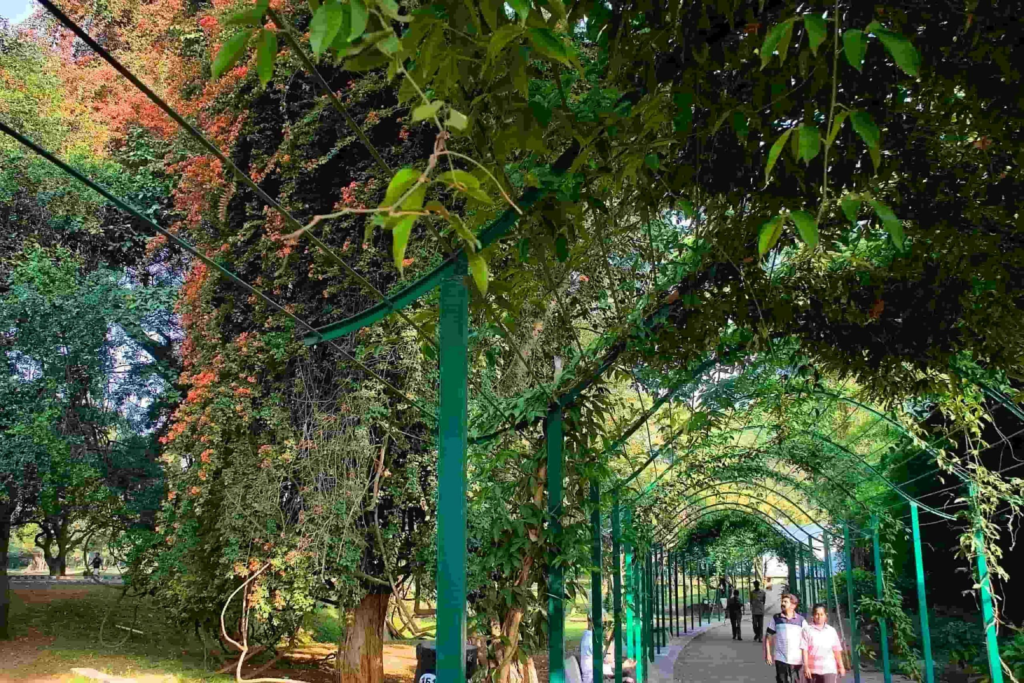
A Slow Two-Hour Plan for Seniors
This is only a guide. Change it as the elder feels.
First 15 minutes: Settle in. Enter slowly. Find the nearest washroom. Ask about the buggy. Sit for a moment if the elder wants to.
Next 30 minutes: Walk to the Glass House area. Take the easiest main path from your gate. Spend time near the Glass House and its lawns. Sit on a bench and drink some water.
Next 30 minutes: Enjoy the garden slowly. Look at the flowers, big trees and the Bonsai Garden near you. Do not try to walk a big loop. If the elder is tired now, this is a good place to stop.
Next 20 minutes: Visit the lake side, if the elder feels fine. Take the easier path. If the ground looks rough or slippery, skip it and rest near the lawns.
Last 25 minutes: Head back. Walk slowly to the exit. If the buggy is running, use it for the last stretch.
Things that are fine to skip:
- The rocky hill
- Long garden loops
- Paths with many steps
- Slippery or crowded areas
What to Carry
Keep the bag light. The family member helping the elder should carry it.
- Comfortable shoes with a good grip
- A water bottle
- The elder’s usual walking stick or walker
- A cap, hat or sunglasses
- A small umbrella if rain is possible
- A charged phone with family contact numbers
- Some cash and a digital payment option
- Any medicines the elder takes regularly
- Tissues and a small towel
- A light snack
- An age proof such as an Aadhaar card
About the ticket: the entry ticket is small, and many visitor guides say senior citizens get free or reduced entry. Rules and rates change, so carry your age proof and ask at the counter.
Tips for Family Members
Plan the trip around the elder’s energy, not around the list of places.
If your parent usually gets tired after 30 to 40 minutes of walking, plan short walks with breaks. A simple pattern is 30 minutes of walking, then 10 minutes of rest.
Look for signs of tiredness. These include slower steps, more frequent stops, losing balance, a pale face, or the person simply saying they want to sit. If you see any of these, stop and rest, even in the middle of a nice spot.
If there are two or three of you, one person can stay with the elder while another checks the path ahead. This helps at slopes, steps and crowded corners.
You can also split the day. Visit Lalbagh for one or two hours in the morning, then go home or have lunch, and let the elder rest. There is no rule that the garden must be seen in one go.
Staying Safe and Comfortable
- Walk slowly on wet paths, especially near stones, slopes and wet leaves
- Stay close to the elder in crowds so you can help if they lose balance
- Keep to the marked paths and avoid restricted lawns
- Take breaks in the shade on hot days
- If the elder feels unwell, stop walking, sit in a safe shaded place and ask nearby garden staff for help
- For any serious health problem, get medical help at once
Everyone’s health is different, so follow the elder’s own doctor’s advice about walking and rest.
Where to Eat and Take a Tea Break
Karnataka Tourism lists food stalls inside Lalbagh, where visitors can find snacks and drinks. Stalls open and close at different times, so keep a small snack in your bag as well.
For a proper meal, choose a place close to the gate you use. A café or restaurant with easy seating and a short walk is a better choice for an elder than a famous place that needs another long walk.
How This Guide Was Prepared
This guide is based on the visitor facilities listed by Karnataka Tourism, news reports from Deccan Herald about Lalbagh’s walkers, buggies and walkways, and public information about the garden. Details were last reviewed in September 2026. Fares, timings and facilities can change, so please confirm the latest details at the ticket counter on the day of your visit.
Frequently Asked Questions
Is Lalbagh Botanical Garden suitable for senior citizens?
Yes. It has wide paths, benches, shade, washrooms and a battery buggy. It is best to visit slowly and skip the rocky hill area.
Is there a buggy for elderly visitors at Lalbagh?
Yes. Karnataka Tourism lists electric buggies as a facility for those who prefer not to walk long distances. Visitors mention a fare of around ₹100 per person. Check the current fare at the counter.
Can a wheelchair be used inside Lalbagh?
Yes, on the flatter main roads and paved paths. Steps, slopes, unpaved stretches and the rocky hill can be hard. Ask the staff at the gate for the easiest route.
Can I drive my car inside Lalbagh?
No. Private cars are not allowed inside the garden. Ask your driver to stop as close to the gate as possible so the elder has a short walk to the entrance.
Which gate is best for senior citizens?
There is no single best gate. Choose the one where your car can stop closest to the entrance, or the one nearest to your metro or bus stop.
Are there benches for elders?
Yes. Benches are found in many parts of the garden, and many are in the shade. On busy days they fill up quickly.
What is the best time for seniors to visit Lalbagh?
Early morning. It is cooler and calmer. Weekday mornings are the most comfortable.
How long should an elder stay in Lalbagh?
About two hours is enough for a slow, relaxed visit with breaks. If the elder gets tired sooner, it is perfectly fine to leave early.
A Slow Visit Is a Good Visit
Lalbagh does not need to be seen from one end to the other. For an elder, a quiet path, a shaded bench and some time among old trees can make the whole trip worthwhile. Pick the easy route, rest often, and go home happy rather than tired.
Read Also: Lalbagh Botanical Garden for Kids: Things to See, Do & Know Before Visiting

Suresh Kumar is the founder and editor of LalbaghBotanicalGarden.com, a website dedicated to helping visitors plan their trips to Lalbagh Botanical Garden with accurate, well-researched information on timings, fees, history, and attractions. Content is compiled and fact-checked using official sources and government tourism records.
Email: worldtuch0007@gmail.com