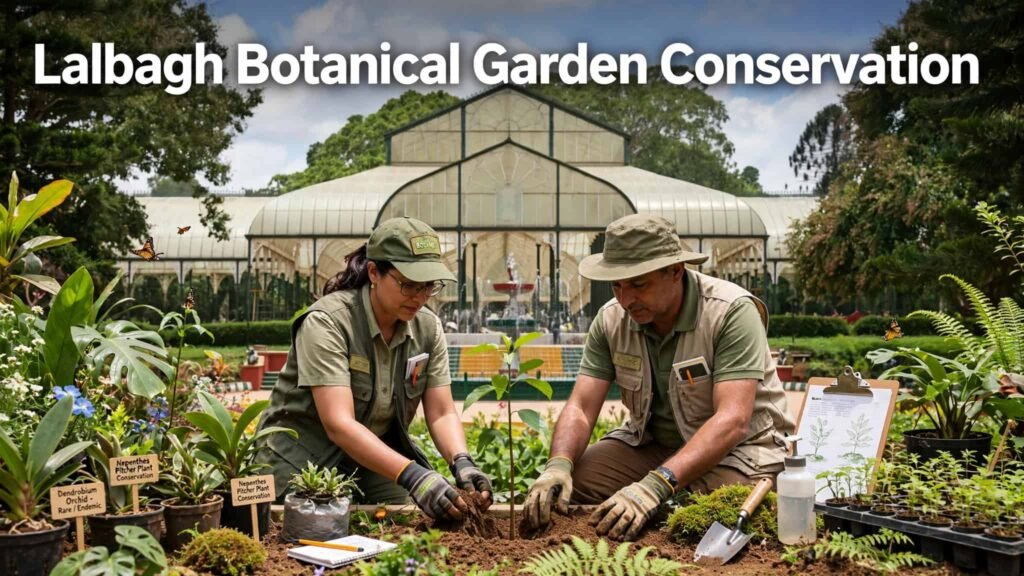
Lalbagh Botanical Garden Conservation: How Plants, Trees & Heritage Features Are Preserved
Lalbagh Botanical Garden is much more than a landscaped park in the middle of Bengaluru. Spread across about 240 acres, it contains thousands of plants and trees, historic landscape features, water bodies, specialised gardens and botanical collections. Karnataka Tourism describes Lalbagh as a centre for botanical research, horticulture education and conservation, and the garden is managed by the Department of Horticulture, Government of Karnataka.
Conserving a garden of this size is a continuous process. It involves caring for mature trees, maintaining plant collections, managing water, protecting soil, raising new plants and balancing public access with the needs of the garden.
Here is how conservation at Lalbagh works and why it matters.

Why Is Conservation Important at Lalbagh?
Lalbagh has developed over centuries and contains plant material from different regions. Its importance therefore isn’t limited to lawns and flower beds.
Karnataka Tourism says the garden has more than 1,854 plant species and includes rare plants as well as very old trees. It also identifies the garden as a place associated with botanical research, horticulture education and conservation.
This makes conservation important for several reasons:
- Protecting mature and heritage trees
- Maintaining botanical collections
- Preserving plant diversity
- Supporting birds and other wildlife
- Managing water sustainably
- Protecting historic landscape features
- Maintaining the garden for future visitors
A botanical garden also provides an opportunity to study plants in a managed environment rather than simply displaying them as decoration.
1. Caring for Lalbagh’s Mature Trees
One of Lalbagh’s most distinctive features is its large collection of mature trees.
Some trees are particularly notable because of their size, age or botanical importance. Karnataka Tourism, for example, highlights the garden’s White Silk Cotton tree (Ceiba pentandra) as an iconic specimen and describes it as approximately 250 years old.
Conserving mature trees requires more than simply watering them.
Garden staff need to consider:
- Tree health
- Soil conditions
- Water availability
- Dead or damaged branches
- Pest and disease problems
- Root-zone conditions
- Visitor safety
- Changes caused by weather
Large trees can take decades or centuries to develop, so replacing them with newly planted trees cannot immediately recreate the same ecological and historical value.
2. Water Conservation at Lalbagh
Water management is one of the most important parts of keeping Lalbagh’s vegetation healthy.
The garden has experienced periods when water availability became difficult. In 2024, officials reported that reduced borewell yields and power problems affecting the sewage-treatment plant made it harder to water plants and trees across the garden. Staff used treated water and transported it to different parts of the garden when necessary.
This shows why water conservation is closely connected with plant conservation.
Rainwater harvesting
Lalbagh has also developed rainwater-harvesting infrastructure.
In 2020, the Horticulture Department inaugurated 209 rainwater-harvesting pits in the garden. The purpose was to increase water-holding and groundwater-recharge capacity without disturbing the garden’s biodiversity.
Recharge wells have also been used to capture rainwater and encourage groundwater replenishment. A 2024 report described recharge wells across Lalbagh and a traditional open well developed inside the garden.

3. Using Treated Water for Irrigation
Another important part of water management is the use of treated wastewater.
Lalbagh has a sewage-treatment plant that can provide treated water for horticultural use. During the difficult summer conditions reported in 2024, officials said treated water from the plant was being used to help maintain the garden when borewell water was insufficient.
More recent reporting in 2025 stated that Lalbagh had more than 240 rainwater-harvesting pits and a sewage-treatment plant supplying treated water for irrigation, alongside borewells.
For a large botanical garden, this kind of water-management system can reduce dependence on a single source.
4. Protecting Plant Collections
Lalbagh is home to plants from different parts of India and other regions of the world.
Its collections include:
- Tropical plants
- Subtropical plants
- Flowering plants
- Ornamental species
- Palms
- Mature trees
- Specialised garden collections
- Nursery plants
Conservation means maintaining these collections over time rather than simply planting new flowers for seasonal displays.
Different species have different requirements for sunlight, moisture, soil, temperature and maintenance. Horticultural staff therefore need to manage individual sections according to the needs of the plants growing there.
5. The Role of Lalbagh Nursery
The nursery is another important part of Lalbagh’s horticultural system.
Karnataka Tourism identifies the nursery as being operated by the Karnataka Horticulture Directorate and says it provides plants, saplings, seeds and gardening supplies.
A nursery can support conservation by providing a controlled environment where plants can be:
- Propagated
- Grown from young stages
- Maintained before planting
- Used for horticultural displays
- Made available to the public
This also makes the nursery useful for people who want to learn about plants and gardening beyond their visit to the main garden.
6. Maintaining Soil and Plant Health
Healthy plants depend on healthy soil.
Routine horticultural work can include:
- Removing unwanted weeds
- Maintaining planting beds
- Improving soil conditions
- Applying organic material where appropriate
- Managing irrigation
- Mulching selected areas
- Monitoring plant health
These activities may not be noticeable to ordinary visitors, but they are essential to maintaining a large botanical garden.
Lalbagh’s horticulture operations include watering, weeding, pruning, seasonal planting, nursery work and pest and disease management.
7. Protecting Biodiversity
Conservation at Lalbagh isn’t limited to individual plants.
A mature garden also creates habitat for birds, insects and other small organisms.
Research on Lalbagh’s vegetation has noted the importance of its mature tree canopy and biodiversity. One study estimated that about 33% of the garden’s 240 acres had thick canopy dominated by large mature trees, based on satellite imagery and field-related analysis.
Trees, shrubs, flowering plants, water bodies and less intensively managed areas can collectively create different habitats.
This is one reason maintaining a variety of plant structures is important.

8. Conserving Historic Features
Lalbagh’s heritage isn’t limited to its plants.
The garden also contains historic and cultural features, including the famous Glass House, Kempegowda Watch Tower, Bandstand and other structures and landscape elements.
The Glass House, in particular, is closely associated with Lalbagh’s horticultural exhibitions and flower shows.
Conservation therefore involves maintaining both the living landscape and the historic features that help explain Lalbagh’s development over time.
9. Balancing Visitors With Conservation
Lalbagh receives large numbers of visitors throughout the year, especially during major flower shows.
Public access is an important part of the garden’s role, but heavy visitor movement can put pressure on lawns, flower beds, soil and planted areas.
Simple visitor behaviour can therefore support conservation:
- Stay on designated paths where requested.
- Don’t climb trees.
- Don’t damage bark or branches.
- Don’t pick flowers or leaves.
- Don’t remove seeds or plant material.
- Dispose of waste properly.
- Follow temporary restrictions around sensitive areas.
- Give gardeners space when maintenance work is underway.
These small actions help protect the garden’s living collections.
What Visitors Can Learn From Lalbagh’s Conservation Work
Lalbagh offers a useful example of how an urban botanical garden has to balance several responsibilities at the same time.
It needs to remain:
- A public green space
- A botanical collection
- A horticultural centre
- A place for education
- A habitat for urban biodiversity
- A historic landscape
Water conservation, mature-tree care, plant propagation and horticultural maintenance all contribute to these objectives.
For visitors, this means Lalbagh can be appreciated in more than one way. You can visit for the flowers and Glass House, but you can also look at how mature trees, plant collections, water systems and landscaped areas work together.
Frequently Asked Questions
Who manages Lalbagh Botanical Garden?
Lalbagh is managed by the Department of Horticulture, Government of Karnataka.
How does Lalbagh conserve water?
The garden uses several approaches, including rainwater-harvesting pits, recharge wells, treated water and other water-management infrastructure.
Why are old trees important at Lalbagh?
Mature trees contribute to the garden’s historical character, provide shade and habitat, and form an important part of its botanical landscape.
Does Lalbagh have a nursery?
Yes. Karnataka Tourism identifies a nursery operated by the Karnataka Horticulture Directorate where visitors can find plants, saplings, seeds and gardening supplies.
Can visitors help conserve Lalbagh?
Yes. Visitors can help by staying on permitted paths, avoiding damage to plants and trees, not picking flowers or leaves, and following garden rules.
Final Thoughts
Lalbagh Botanical Garden conservation is a continuous process involving much more than planting flowers. Mature-tree care, water conservation, rainwater harvesting, plant propagation, soil management, biodiversity protection and heritage maintenance all contribute to keeping the garden healthy.
For visitors, understanding this hidden side of Lalbagh can make a normal walk through the garden more interesting. Behind the lawns and flower displays is a large horticultural system that requires year-round care.
Lalbagh’s greatest value isn’t just what visitors can see during a single visit. It is also the effort required to preserve its living collections, mature trees and historic landscape for the years ahead.
Author: Suresh Kumar
Founder & Editor, LalbaghBotanicalGarden.com
Read Also: Lalbagh Plant Collections: Gardens, Displays & Botanical Diversity

Suresh Kumar is the founder and editor of LalbaghBotanicalGarden.com, a website dedicated to helping visitors plan their trips to Lalbagh Botanical Garden with accurate, well-researched information on timings, fees, history, and attractions. Content is compiled and fact-checked using official sources and government tourism records.
Email: worldtuch0007@gmail.com