Lalbagh Glass House: History, Architecture and Significance
The Lalbagh Glass House is one of the most recognizable landmarks inside Lalbagh Botanical Garden. Located in the heart of Bengaluru, this historic iron-and-glass structure is closely associated with the city’s long horticultural tradition and its famous flower shows.
Built in the late 19th century, the Glass House was inspired by London’s Crystal Palace and was originally designed to support horticultural exhibitions and the cultivation and display of plants. More than a century later, it continues to serve as the main venue for Lalbagh’s major flower shows.
Quick Facts About Lalbagh Glass House
| Feature | Details |
|---|---|
| Location | Lalbagh Botanical Garden, Bengaluru, Karnataka |
| Foundation stone | November 30, 1889 |
| Completed | Around 1890–91 |
| Original name | Albert Victor Conservatory |
| Associated with | John Cameron, Superintendent of Lalbagh |
| Architectural inspiration | London’s Crystal Palace |
| Main materials | Iron and glass |
| Original purpose | Conservatory and horticultural exhibitions |
| Present use | Flower shows and horticultural exhibitions |
| Major refurbishment | 2002–04 period |
Historical sources differ slightly in describing the exact completion date, but they consistently place the foundation in 1889 and the construction of the Glass House around 1890–91.
History of Lalbagh Glass House
The story of the Glass House is connected to the development of Lalbagh as an important botanical and horticultural centre.
During the 19th century, Lalbagh’s flower exhibitions had become increasingly popular. Earlier exhibitions were held in and around the garden’s bandstand, but a permanent structure was eventually considered necessary for displaying flowers and plants.
John Cameron, who served as Superintendent of Lalbagh for many years, was associated with the development of the new conservatory. The foundation stone was laid on 30 November 1889 by Prince Albert Victor, the Prince of Wales and grandson of Queen Victoria, during his visit to Bengaluru. The building was subsequently known as the Albert Victor Conservatory.
The Glass House was designed along the lines of London’s famous Crystal Palace, which had been constructed for the Great Exhibition of 1851. The connection with the Crystal Palace reflects the influence of contemporary Victorian horticultural and exhibition architecture on Lalbagh.
Why was the Glass House built?
The building had a practical horticultural purpose. It provided a protected environment for plants and offered a permanent venue for flower and horticultural exhibitions.
The Glass House eventually became closely linked with Lalbagh’s biannual flower-show tradition, which remains one of the garden’s best-known attractions.
Architecture of Lalbagh Glass House

The architecture of the Lalbagh Glass House is what makes it particularly distinctive.
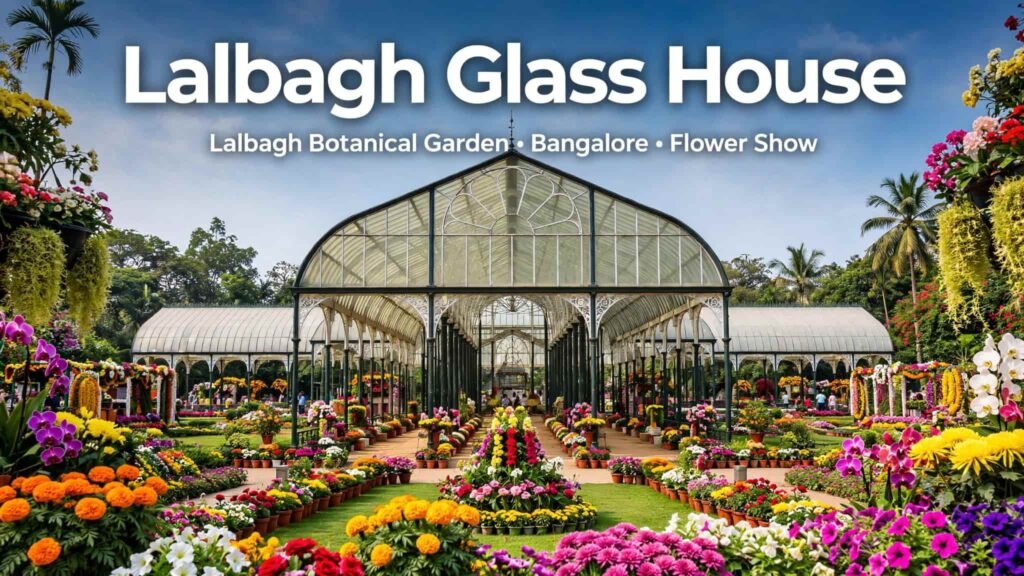
Its design combines a large iron framework with extensive glass surfaces, creating a spacious conservatory that allows natural light to reach the interior. The structure reflects the Victorian-era fascination with iron-and-glass architecture.
Historical accounts state that the iron components were produced by Walter Macfarlane and Company of Glasgow, while contemporary accounts also note the use of imported glass.
1. Iron-and-glass construction
The most noticeable feature is the combination of slender metal supports and large glass panels. Instead of relying on massive masonry walls, the building uses a relatively lightweight structural system.
This gives the interior an open and airy appearance while allowing considerable daylight inside.
2. Crystal Palace influence
The Glass House was inspired by London’s Crystal Palace. The Crystal Palace became famous for demonstrating how iron and glass could be used to create enormous exhibition spaces.
The Lalbagh structure adapted this architectural idea to a much smaller scale and a different climate and horticultural purpose.
3. Symmetrical design
The building’s central section and projecting wings create a strong sense of symmetry. From the main approach to the Glass House, visitors can see the central entrance framed by the glass-and-iron structure and surrounding lawns.
This symmetry also makes the building particularly striking when viewed from the garden pathways.
4. Large glazed surfaces
The extensive glass surfaces serve both an architectural and horticultural function. They allow daylight into the building while providing a controlled environment for exhibitions.
The glass also creates constantly changing views of the surrounding trees and gardens, making the structure appear different depending on the weather and time of day.
Changes and Restoration of the Glass House
Like any historic structure exposed to Bengaluru’s weather and heavy visitor use, the Glass House has required maintenance and refurbishment over the years.
By the early 2000s, the structure required substantial work. A major refurbishment was carried out around 2002–04, including replacement of old glazing and work to improve the building’s condition. The refurbished Glass House was reopened to the public in January 2004.
The refurbishment was particularly important because the building continues to host large flower exhibitions. Modern safety glass and other improvements were introduced while retaining the historic character of the structure.
Another interesting detail is that the Glass House did not always look exactly as it does today. Historical accounts mention that its sides once had wooden trellises covered with creepers. These were later removed, partly to improve ventilation and reduce heat inside the structure.
Lalbagh Glass House and Flower Shows

Today, the Glass House is perhaps best known as the centre of Lalbagh’s famous flower shows.
The garden traditionally hosts major flower exhibitions around Republic Day in January and Independence Day in August. During these events, the normally spacious interior of the Glass House is transformed with thousands of flowers, themed displays, floral sculptures and horticultural exhibits.
The exhibitions also demonstrate how the historic building continues to perform the function for which it was created more than a century ago.
During large flower shows, maintaining suitable conditions inside the Glass House can be challenging because the enclosed space becomes warmer with large crowds. Modern horticultural techniques, including misting systems, have been used to help maintain the freshness of flowers during exhibitions.
Why Is Lalbagh Glass House Significant?
The importance of the Glass House goes beyond its appearance.
A landmark of Bengaluru’s horticultural history
Lalbagh has played an important role in the development of horticulture in Bengaluru and the former Mysore region. The Glass House became an important physical space for showcasing plants, flowers and horticultural achievements.
A surviving example of Victorian-era architecture
The structure demonstrates the late-19th-century use of iron and glass in large public buildings. Its connection to the Crystal Palace makes it an interesting example of how international architectural ideas were adapted in India.
A link between history and modern events
One of the most interesting aspects of the Glass House is that it is not simply a preserved historic monument. It remains an active exhibition space.
Visitors can see the same basic structure being used for horticultural displays more than 130 years after its foundation was laid.
A symbol of Lalbagh
For many visitors, the Glass House is visually synonymous with Lalbagh itself. Photographs of the garden frequently feature its distinctive glass-and-iron façade, particularly during flower shows.
What Makes Lalbagh Glass House Different From Other Structures in Bengaluru?
Bengaluru has several historic buildings and green spaces, but the Glass House has a distinctive combination of architecture, horticulture and public events.
It is simultaneously:
- A historic 19th-century structure
- An example of iron-and-glass architecture
- A horticultural exhibition venue
- The main setting for Lalbagh’s flower shows
- A major visual landmark inside Lalbagh Botanical Garden
Its significance therefore comes not from architecture alone but from the way the building has remained connected with Bengaluru’s horticultural culture.
Best Time to See the Glass House
The Glass House can be appreciated throughout the year, but the experience changes considerably depending on when you visit.
During flower shows:
The building is at its most colourful, with large floral displays filling the interior. However, these periods are also considerably busier.
On ordinary days:
The quieter surroundings make it easier to appreciate the iron framework, glass panels, symmetry and relationship between the building and the surrounding garden.
Early morning or late afternoon:
The changing natural light can make the glass and metal framework particularly attractive for photography.
Frequently Asked Questions
When was Lalbagh Glass House built?
The foundation stone was laid on 30 November 1889, and the Glass House was completed around 1890–91. Some historical sources simply describe it as having been built in 1889 or 1890.
Who built Lalbagh Glass House?
The Glass House was developed during the tenure of John Cameron, the Superintendent of Lalbagh. Its iron components were associated with Walter Macfarlane and Company of Glasgow.
What is Lalbagh Glass House modeled after?
It was modeled on or inspired by London’s Crystal Palace, the famous iron-and-glass exhibition building associated with the Great Exhibition of 1851.
What was the original name of Lalbagh Glass House?
The structure was originally known as the Albert Victor Conservatory, named in connection with Prince Albert Victor, who laid its foundation stone.
What is Lalbagh Glass House used for today?
It is primarily associated with flower shows and horticultural exhibitions, particularly Lalbagh’s major Republic Day and Independence Day flower shows.
Is Lalbagh Glass House still the original structure?
The historic structure survives, although it has undergone maintenance and refurbishment. Significant refurbishment around 2002–04 included replacement of glazing and improvements intended to preserve and safely use the building.
Conclusion
The Lalbagh Glass House is much more than an attractive building inside a botanical garden. Its history begins in the late 19th century, when Bengaluru’s horticultural traditions were expanding and a permanent exhibition and conservatory space was needed.
Inspired by London’s Crystal Palace and developed during John Cameron’s tenure, the structure brought Victorian iron-and-glass architecture into the landscape of Lalbagh. Its continuing use for flower shows gives the building an unusual connection between heritage and living horticultural tradition.
More than a century after its foundation, the Glass House remains one of the defining sights of Lalbagh Botanical Garden. Whether viewed as an architectural landmark, a piece of Bengaluru’s horticultural history, or the centre of the city’s famous flower shows, it remains an important part of the city’s heritage.
Read Also: Lalbagh Bonsai Garden: A Complete Visitor Guide

Suresh Kumar is the founder and editor of LalbaghBotanicalGarden.com, a website dedicated to helping visitors plan their trips to Lalbagh Botanical Garden with accurate, well-researched information on timings, fees, history, and attractions. Content is compiled and fact-checked using official sources and government tourism records.
Email: worldtuch0007@gmail.com