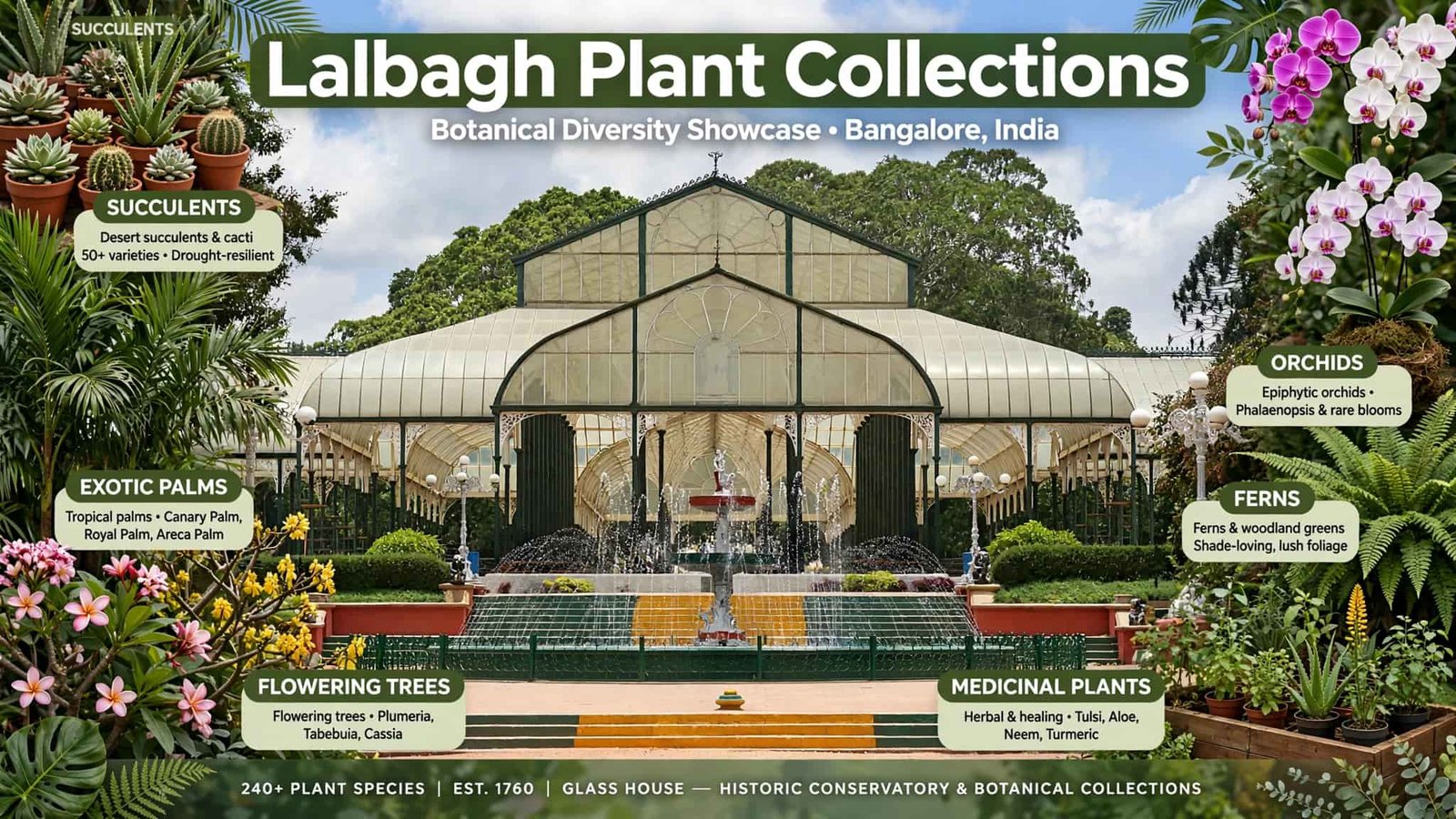










Lalbagh Botanical Garden may look effortless when you walk through its lawns, tree-lined paths and flower beds, but maintaining a garden of this scale requires continuous horticultural work.
From watering plants and maintaining lawns to pruning trees, preparing flower beds, managing nurseries and protecting rare plant collections, much of Lalbagh’s appearance depends on the daily work carried out by horticulture staff and gardeners.
Lalbagh is managed by the Department of Horticulture, Government of Karnataka, which oversees the garden’s horticultural activities and associated facilities such as the nursery and Horticulture Information Centre.

How Is Lalbagh Botanical Garden Managed?
Lalbagh is not simply maintained like an ordinary public park. It contains lawns, flower beds, mature trees, botanical collections, nurseries, the Glass House, heritage features and specialised gardens.
The Department of Horticulture is responsible for managing the garden and its horticultural operations. Karnataka Tourism also notes that the nursery is operated by the Horticulture Directorate and that Lalbagh has a Horticulture Information Centre.
The work can broadly be divided into:
- Plant and tree care
- Lawn maintenance
- Watering and irrigation
- Weeding and soil care
- Pruning and trimming
- Nursery management
- Seasonal flower cultivation
- Flower Show preparation
- Pest and disease management
- Maintenance of botanical collections
- Landscaping and visitor-area upkeep
Daily Horticultural Work at Lalbagh
A large garden requires routine work throughout the year rather than only during flower shows.
Gardeners are assigned different sections and responsibilities. Historical reporting on Lalbagh’s gardening staff describes duties ranging from watering individual pots to caring for specific gardens, flower beds and the Glass House area.
Typical horticultural work includes:
1. Watering Plants
Water management is one of the most important jobs at Lalbagh.
Different plants have different water requirements, and summer can be particularly challenging. In March 2024, Lalbagh authorities reported difficulties maintaining its plants and trees because borewell yields had fallen and the garden was dealing with reduced water availability. Staff used treated water from the sewage-treatment plant and transported water around the garden when necessary.

This shows why irrigation at Lalbagh involves more than simply turning on sprinklers.
2. Weeding and Soil Maintenance
Weeds compete with ornamental plants and trees for water, nutrients and space.
Removing unwanted growth from soil and flower beds is therefore a regular horticultural activity.
A 2024 Department of Horticulture document specifically records a soil-weeding activity at Lalbagh, demonstrating that weeding is part of the garden’s ongoing maintenance work.
Garden beds may also require loosening of soil, adding organic material and mulching depending on the plant and location.
3. Pruning and Trimming
Pruning helps horticulture staff manage the shape, growth and health of plants.
Depending on the species and location, pruning can involve:
- Removing dead branches
- Cutting back overgrown growth
- Shaping ornamental plants
- Maintaining hedges
- Removing damaged plant parts
- Managing branches around pathways
Tree management can be particularly important in a historic garden containing many mature trees.
How Lalbagh Manages Water During Difficult Summers
Water availability can become a major management challenge during Bengaluru’s hotter and drier periods.
In 2024, Lalbagh officials said that five borewells were producing less water and that power fluctuations were affecting the garden’s 1.5-million-litre-per-day sewage treatment plant. Staff therefore used treated water and transported it to areas where it was needed.
This also illustrates why Lalbagh’s maintenance is a continuous operational process.
The garden has to balance the water requirements of:
- Mature trees
- Flower beds
- Lawns
- Nursery plants
- Seasonal displays
- Special plant collections

Nursery Work at Lalbagh
The nursery is another important part of Lalbagh’s horticultural system.
Karnataka Tourism identifies the Lalbagh nursery as being operated by the Karnataka Horticulture Directorate. Visitors can find plants, saplings, seeds and gardening supplies there.
Nursery work can include:
- Raising seedlings and saplings
- Potting plants
- Watering young plants
- Maintaining growing media
- Moving plants between growing areas
- Caring for seasonal flowering plants
- Preparing plants for displays and landscaping
The nursery therefore serves not only visitors who want to purchase plants but also contributes to Lalbagh’s wider horticultural activities.
Seasonal Flower Cultivation
Lalbagh’s appearance changes considerably throughout the year.
Flower beds and displays are planned around seasonal flowering cycles. Plants may be raised or maintained specifically for particular seasons and horticultural exhibitions.
The Flower Shows are especially labour-intensive because thousands of plants and flowers may need to be arranged into themed displays.
For example, preparations for Lalbagh’s Flower Shows have involved gardeners arranging large numbers of potted plants and creating elaborate floral installations.

How Gardeners Prepare for the Lalbagh Flower Show
The famous Flower Show requires additional horticultural planning.
Before visitors arrive, workers may have to:
- Grow and prepare flowering plants
- Move potted plants into position
- Arrange plants according to the display design
- Maintain flowers during the exhibition
- Replace damaged or declining plants
- Water the displays
- Keep the exhibition area presentable
Large installations can require hundreds or thousands of individual plants.
During one Lalbagh Flower Show, workers were photographed arranging vertical structures filled with flowering plants, showing the amount of hands-on work involved in creating the displays.
Caring for Special Plant Collections
Lalbagh contains several specialised horticultural areas, including the Bonsai Garden, Rose Garden, Hibiscus Garden, Topiary Garden and nursery. Karnataka Tourism also highlights the garden’s extensive plant collections and notable old trees.
These areas cannot necessarily be managed in exactly the same way.
For example:
- Bonsai require specialised pruning and watering.
- Roses require regular care to maintain flowering.
- Topiary plants need shaping.
- Young nursery plants need different watering and protection than established trees.
- Mature heritage trees require monitoring and careful management.
This makes horticultural management at Lalbagh more specialised than ordinary lawn maintenance.
Pest and Plant Disease Management
Plants growing in a large botanical garden can be affected by insects, fungal problems and other plant-health issues.
Lalbagh horticulture staff have used different approaches depending on the plant and problem.
In a large-scale Western Ghats planting project at Lalbagh, officials described using neem oil to control pests on affected plants. The same project used mulching with fallen leaves to retain moisture around newly planted saplings.
This is an example of how horticultural management can combine plant protection with moisture-conservation techniques.
Mulching and Recycling Garden Material
Fallen leaves are a natural resource in a large garden.
Instead of treating every fallen leaf simply as waste, organic material can be used around plants as mulch.
During the Western Ghats planting project at Lalbagh, fallen leaves were placed around saplings to help retain moisture in the soil.
Mulching can help:
- Reduce moisture loss
- Protect soil
- Moderate soil temperature
- Add organic matter as material decomposes
- Reduce competition from some weeds
The exact approach depends on the plant and area being maintained.
How Manpower Supports Lalbagh’s Maintenance
Behind the greenery is a large amount of manual work.
Gardeners and horticulture workers handle tasks such as watering, trimming, weeding, planting, moving pots and maintaining flower beds.
Recent reporting has also highlighted manpower challenges within Bengaluru’s major public gardens. A 2025 report said Lalbagh had about 50 gardeners against 120 sanctioned positions, with contract workers helping meet staffing needs.
This gives visitors some idea of the scale of work required to maintain a large historic garden.
Horticulture and Lalbagh’s Heritage
Lalbagh is not only a recreational green space. Its history is closely connected with horticulture in Bengaluru.
The BBMP’s historical account of Karnataka’s Horticulture Department notes that Lalbagh’s development expanded significantly under John Cameron from the late 19th century, including the introduction and cultivation of numerous native and exotic plants.
Today, maintaining that horticultural legacy means balancing several objectives:
- Conserving established trees and plants
- Maintaining botanical collections
- Growing seasonal flowers
- Providing attractive public spaces
- Supporting horticultural education
- Managing visitor pressure
- Preparing major exhibitions
What Visitors Usually Don’t See
When visitors walk through Lalbagh, they mostly see the finished landscape.
The less visible work happens before and after visiting hours and throughout the year.
A well-maintained flower bed, for example, may involve:
Plant selection → nursery preparation → planting → watering → weeding → pruning → pest monitoring → replacement → regular maintenance
The same principle applies to lawns, ornamental plants, hedges and seasonal displays.
That continuous cycle is what keeps Lalbagh looking like a functioning botanical garden rather than simply an open green space.
Why Maintaining Lalbagh Is Challenging
Several factors make Lalbagh’s horticultural management demanding.
Large area
The garden covers a very large area and contains numerous different landscapes and plant collections.
Diverse plants
Different species have different requirements for sunlight, water, soil and pruning.
Bengaluru weather
Seasonal changes affect watering requirements, flowering and plant growth.
Heavy visitor use
Large numbers of visitors can put pressure on lawns, paths and planted areas.
Mature trees
Old and large trees require careful monitoring and management.
Flower Shows
Twice-yearly major floral exhibitions require additional preparation and coordination.
Water availability
Dry periods can put additional pressure on irrigation and water resources, as demonstrated during the 2024 water shortage.
Frequently Asked Questions
Who manages Lalbagh Botanical Garden?
Lalbagh Botanical Garden is managed by the Department of Horticulture, Government of Karnataka.
What type of work do gardeners do at Lalbagh?
Gardeners carry out activities such as watering, weeding, planting, pruning, maintaining lawns and flower beds, caring for nursery plants and preparing floral displays.
How does Lalbagh manage water?
Water is supplied through the garden’s available water sources and treated water systems. During periods of reduced borewell yield, staff have transported treated water to different parts of the garden.
Does Lalbagh have its own nursery?
Yes. The Lalbagh nursery is operated by the Karnataka Horticulture Directorate and offers plants, saplings, seeds and gardening-related materials.
Do gardeners prepare the Flower Show displays?
Yes. Horticulture staff and workers are involved in preparing and maintaining the extensive floral displays and installations used during Lalbagh Flower Shows.
Why is horticultural maintenance important at Lalbagh?
Regular horticultural work helps maintain the garden’s plant collections, lawns, flower beds, trees, nursery and seasonal displays while preserving its role as a historic botanical garden.
Final Thoughts
The greenery visitors see at Lalbagh is the result of continuous horticultural work.
Watering, weeding, pruning, planting, nursery care, pest management, soil maintenance and seasonal flower preparation all contribute to the garden’s appearance and plant health.
The next time you walk through Lalbagh Botanical Garden, it is worth looking beyond the flowers and large trees. Much of the garden’s character comes from the gardeners and horticulture teams who work behind the scenes throughout the year.
Related Lalbagh guide: Lalbagh Nursery: Plants, Saplings, Timings & Visitor Guide

Suresh Kumar is the founder and editor of LalbaghBotanicalGarden.com, a website dedicated to helping visitors plan their trips to Lalbagh Botanical Garden with accurate, well-researched information on timings, fees, history, and attractions. Content is compiled and fact-checked using official sources and government tourism records.
Email: lalbaghgardenbangalore@gmail.com