







Lalbagh Botanical Garden is known for its historic landscape, extensive plant collections, and impressive old trees. Spread across a large green area in Bengaluru, Lalbagh has developed over centuries and contains trees that reflect different periods of the garden’s history.
Some trees at Lalbagh are particularly notable because of their age, size, rarity, or botanical importance. Walking through the garden can therefore feel different from visiting an ordinary urban park. Along with flowering plants and landscaped sections, visitors can find massive trunks, broad canopies, unusual species, and trees that have stood in the garden for generations.
For anyone interested in heritage trees in Lalbagh, the garden offers an opportunity to see how Bengaluru’s historic green spaces have evolved over time.
A Brief History of Lalbagh’s Trees
Lalbagh has a history going back to the 18th century. The garden was initially developed during the rule of Hyder Ali and was later expanded and developed under Tipu Sultan and subsequent administrations.
Over the years, plants and trees were introduced from different parts of India and other regions. The garden gradually became an important botanical collection as well as a major public green space.
Because of this long history, Lalbagh’s vegetation is not limited to recently planted ornamental trees. Some established specimens have been growing for many decades, while certain trees are associated with the garden’s historical landscape.
This long continuity is one of the reasons Lalbagh is significant for people interested in Bengaluru’s botanical and environmental heritage.
Famous Trees and Tree Groups to See at Lalbagh
Lalbagh contains many interesting trees, but visitors looking specifically for old or remarkable specimens should pay attention to the following types of trees and notable areas.
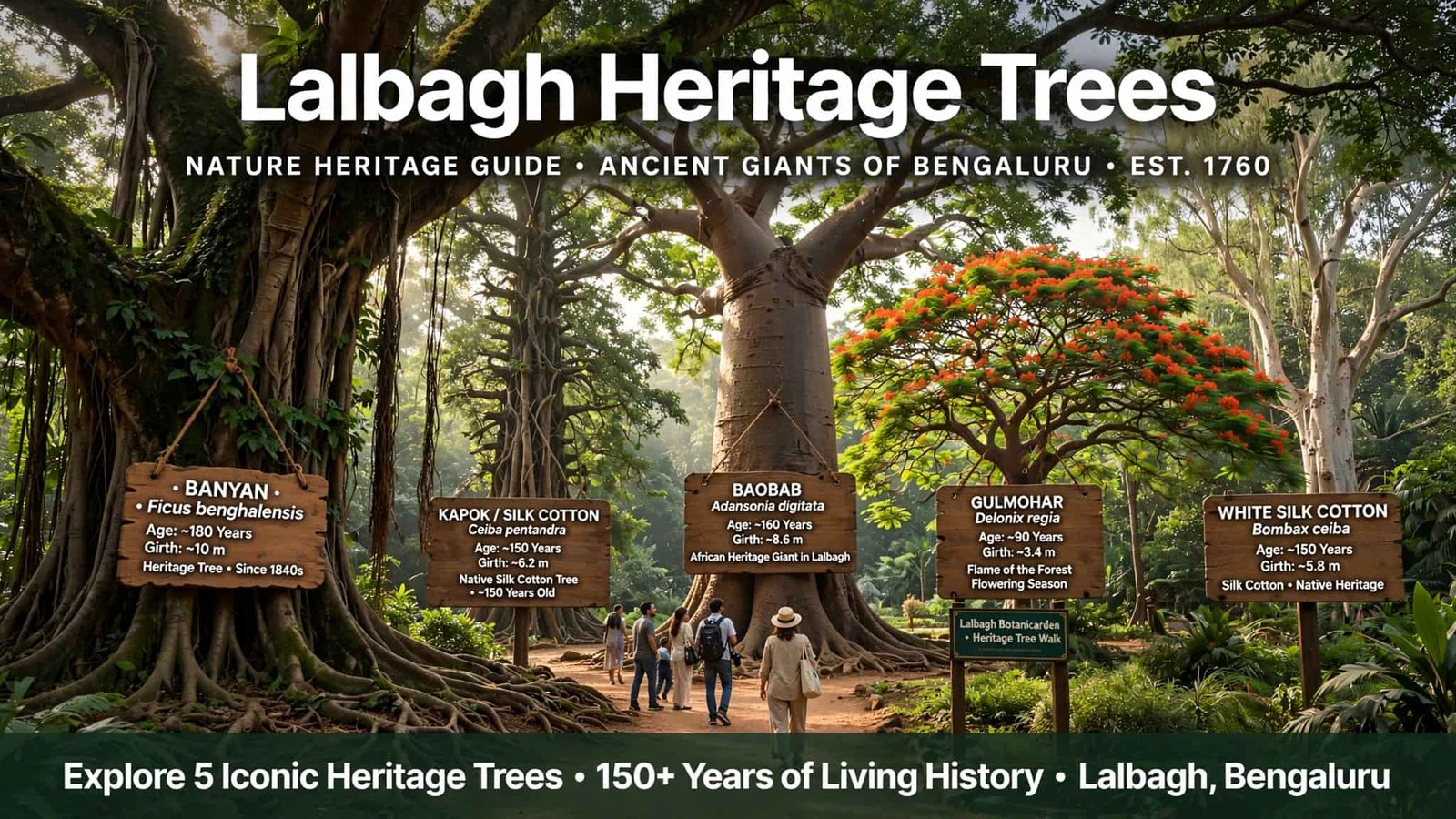
1. The Giant Silk Cotton Tree

The silk cotton tree (Bombax ceiba) is one of the striking large trees found in Indian botanical landscapes. It can develop a substantial trunk and a broad crown, making mature specimens particularly impressive.
At Lalbagh, large trees such as these contribute to the garden’s characteristic old-growth appearance. During the flowering season, silk cotton trees can also become visually distinctive when their flowers appear on relatively bare branches.
Why see it: Its size, unusual trunk structure, and seasonal flowering make mature silk cotton trees worth looking for.
2. Rain Trees

Large rain trees (Samanea saman) are an important part of Bengaluru’s urban tree heritage. The species is famous for its expansive canopy and horizontal branches.
Mature rain trees can create enormous areas of shade beneath their crowns. Their broad structure is particularly noticeable when compared with smaller ornamental trees elsewhere in the garden.
For visitors exploring Lalbagh on foot, these large canopy trees also demonstrate why mature trees are such an important part of the character of historic gardens.
Why see it: The enormous canopy and spreading branches make mature rain trees among the most impressive trees in the landscape.
3. Banyan Trees

The banyan tree (Ficus benghalensis) is one of India’s most recognizable trees. Mature banyans are particularly fascinating because they can develop aerial roots that eventually form additional supporting trunks.
At Lalbagh, large fig trees and other mature specimens add considerable character to the garden. Their dense foliage provides shelter for birds and insects and creates a cooler environment beneath the canopy.
When looking at a large banyan, notice how the tree can occupy much more space than its original trunk suggests.
Why see it: A mature banyan demonstrates how a single tree can gradually develop an extensive network of branches and supporting roots.
4. Mahogany Trees

Mahogany trees are another group worth noticing while walking around Lalbagh. Mature mahogany trees can grow tall and develop substantial trunks, giving them a distinctly different appearance from spreading canopy trees.
Their height becomes especially noticeable when viewed from a distance or alongside smaller ornamental plants.
For visitors interested in tree identification, mahogany also provides an interesting example of how introduced tree species have become part of Bengaluru’s botanical landscape.
Why see it: Tall growth, mature trunks, and historical plant collections make mahogany trees interesting specimens to observe.
5. Cannonball Tree

The cannonball tree (Couroupita guianensis) is one of the more unusual trees visitors may encounter in tropical botanical gardens.
It is particularly famous for producing flowers and large, round fruits directly from its trunk and major branches. The unusual arrangement makes it easy to distinguish from many conventional garden trees.
The tree is also known for its attractive flowers, which can appear in clusters along the trunk.
Why see it: Its trunk-borne flowers and large spherical fruits make it one of the more unusual trees to look for at Lalbagh.
6. Java Plum and Other Large Fig Trees

Large native and naturalized trees such as jamun (Syzygium cumini) contribute to the ecological diversity of Lalbagh.
Jamun trees can become large and long-lived, with dense foliage that provides valuable habitat for birds and other organisms. Their fruit is also familiar throughout India.
Large fig species are similarly important because figs can support a variety of wildlife. When walking through Lalbagh, visitors can therefore look beyond flowers and ornamental plants and appreciate the ecological role of mature trees.
Trees With Heritage Value at Lalbagh
Not every old tree has to be officially designated as a “heritage tree” to be historically interesting.
A tree may attract attention because of:
- Its considerable age
- Large trunk circumference
- Unusual height or canopy
- Botanical rarity
- Historical association
- Introduction into the garden during an earlier period
- Importance to local biodiversity
This is an important distinction when discussing century-old trees at Lalbagh. Tree ages can sometimes be estimated rather than precisely documented, particularly for very old specimens.
Visitors should therefore avoid assuming that every particularly large tree is necessarily hundreds of years old.
Why Lalbagh’s Old Trees Are Important

The old trees of Lalbagh have importance beyond their appearance.
Environmental importance
Large mature trees absorb carbon dioxide, release oxygen, provide shade, and help moderate local temperatures. Their branches and foliage also provide habitat for birds, insects, and other organisms.
Historical importance
Trees that have survived for decades become part of the visual history of a place. In a historic garden such as Lalbagh, mature trees help preserve the character of earlier landscapes.
Educational importance
Because Lalbagh contains trees from different botanical groups, it provides an outdoor setting where visitors can learn about tree species, growth patterns, flowering, fruiting, and plant conservation.
Landscape importance
Large trees give Lalbagh much of its distinctive character. Their canopies create shaded walking routes and provide contrast to flower beds, lawns, and landscaped sections.
How to Spot Old Trees During Your Lalbagh Visit
You don’t need to be a botanist to appreciate Lalbagh’s mature trees. Look for a few simple characteristics.
Look at the trunk
A very large trunk can indicate a mature tree, although trunk size alone cannot accurately determine age.
Observe the canopy
Older trees often have extensive crowns with large branches extending in several directions.
Check for aerial roots
Banyan and some other fig species can develop aerial roots, which may eventually become supporting structures.
Look for tree labels
Botanical gardens often label important plant specimens. A label can provide the scientific name and sometimes additional information about the species.
Notice seasonal changes
Some trees are much easier to identify when they are flowering or fruiting. If you visit Lalbagh at different times of the year, the same tree can look completely different.
Best Time to See Lalbagh’s Trees

The garden’s trees can be enjoyed throughout the year, but the experience changes with the seasons.
Early morning is particularly pleasant for walking because the garden is generally cooler and quieter than during the busier parts of the day.
The monsoon season brings lush greenery, while different trees flower and fruit at different times of the year.
If your primary interest is tree photography, morning light can also provide good conditions for photographing large trunks, branches, and canopies.
Tips for Exploring Lalbagh’s Heritage Trees
If you are visiting specifically to see old and unusual trees, keep these tips in mind:
- Allow enough time. Lalbagh is much larger than a typical neighborhood park.
- Walk slowly. Some interesting specimens are easy to overlook when moving quickly between major attractions.
- Read plant labels. Scientific names can help you identify trees later.
- Carry water, particularly during warmer months.
- Avoid climbing trees or damaging bark.
- Do not collect leaves, flowers, fruits, or other plant material.
- Use the garden’s designated paths wherever possible.
- Take photographs without disturbing other visitors or plants.
Lalbagh Is More Than a Flower Garden
Many people associate Lalbagh primarily with its famous Glass House and flower shows. However, its mature trees are an equally important part of the garden’s identity.
The combination of old trees, botanical collections, lawns, pathways, flowering plants, and historic structures gives Lalbagh a landscape that has developed over a very long period.
For visitors interested in heritage trees, century-old trees, botanical gardens, and Bengaluru’s natural history, simply walking through the tree-lined areas can be one of the most rewarding parts of a visit.
Frequently Asked Questions
Are there century-old trees at Lalbagh?
Lalbagh contains many mature and historically significant trees, and some specimens are believed or documented to be very old. However, the exact age of an individual tree should be confirmed through official botanical or horticultural records rather than estimated only from its size.
Which is the most famous old tree in Lalbagh?
Lalbagh has several notable mature trees and tree groups rather than one universally recognized “oldest tree.” Large banyans, rain trees, silk cotton trees, and other mature specimens are among the types worth looking for.
Can visitors see rare trees at Lalbagh?
Yes. Lalbagh is a botanical garden with a diverse collection of plants, including numerous tree species. Plant labels and garden information can help visitors identify individual specimens.
What should I look for when visiting Lalbagh?
Look for large trunks, expansive canopies, unusual bark, aerial roots, tree labels, flowers, fruits, and distinctive growth patterns. These features can make the tree-spotting experience much more interesting.
Is Lalbagh good for tree photography?
Yes. Its mature trees offer plenty of subjects for photography, from massive trunks and spreading canopies to flowers, fruits, and unusual tree structures. Early morning can be especially pleasant for photography and walking.
Final Thoughts
The heritage and century-old trees at Lalbagh are an important part of Bengaluru’s botanical heritage. While the garden’s Glass House, flower shows, and landscaped sections attract many visitors, its mature trees reveal another side of Lalbagh’s long history.
From expansive rain-tree canopies and banyans to silk cotton, mahogany, cannonball, jamun, and other mature species, there is plenty to discover beyond the garden’s famous attractions.
If you take time to slow down and look closely at the trees during your visit, Lalbagh becomes not just a place to see flowers but a living botanical landscape shaped by generations of planting, growth, and conservation.
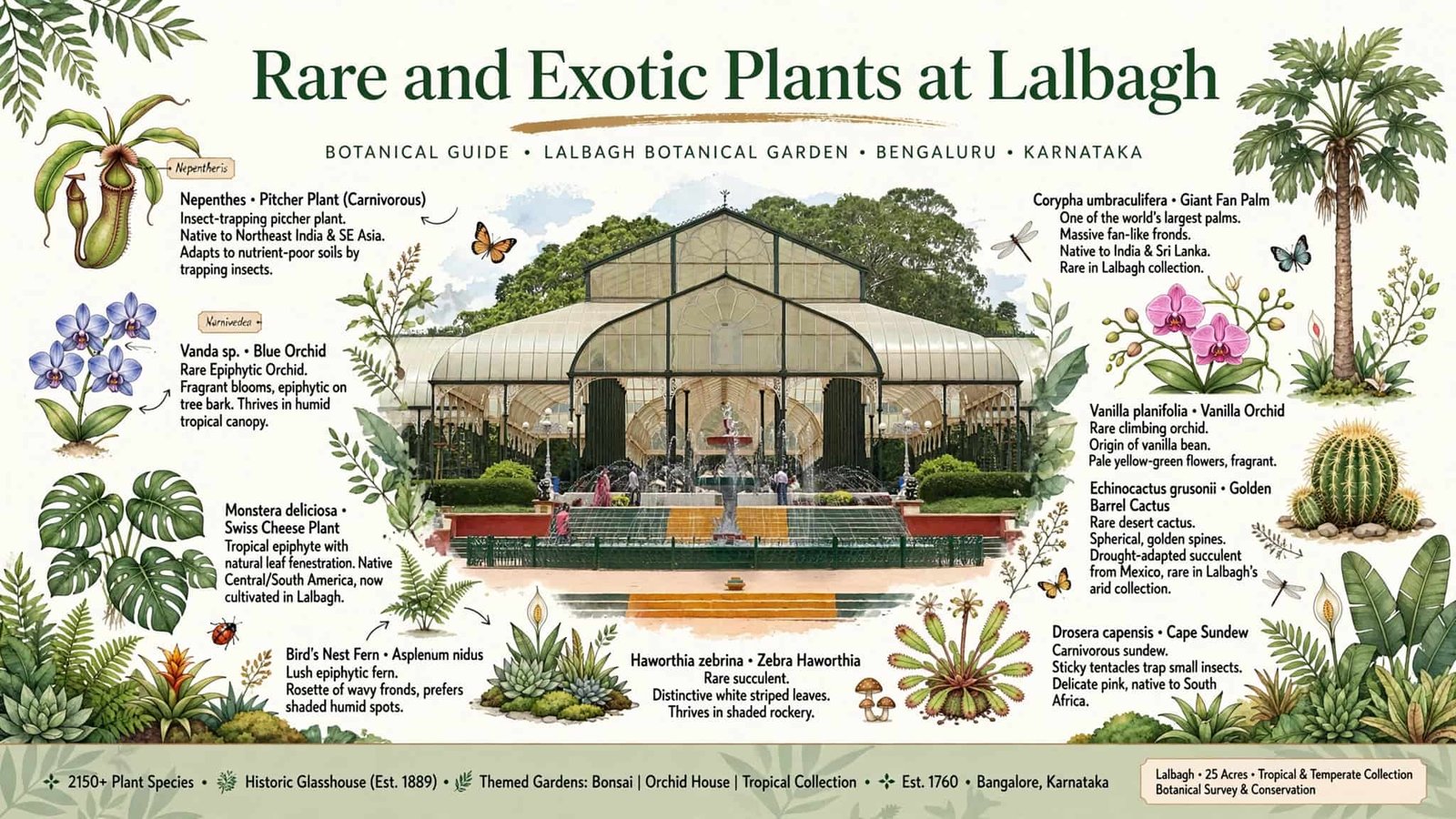
Check also: Rare & Exotic Plants at Lalbagh: Notable Species & Botanical Collection

Suresh Kumar is the founder and editor of LalbaghBotanicalGarden.com, a website dedicated to helping visitors plan their trips to Lalbagh Botanical Garden with accurate, well-researched information on timings, fees, history, and attractions. Content is compiled and fact-checked using official sources and government tourism records.
Email: lalbaghgardenbangalore@gmail.com