








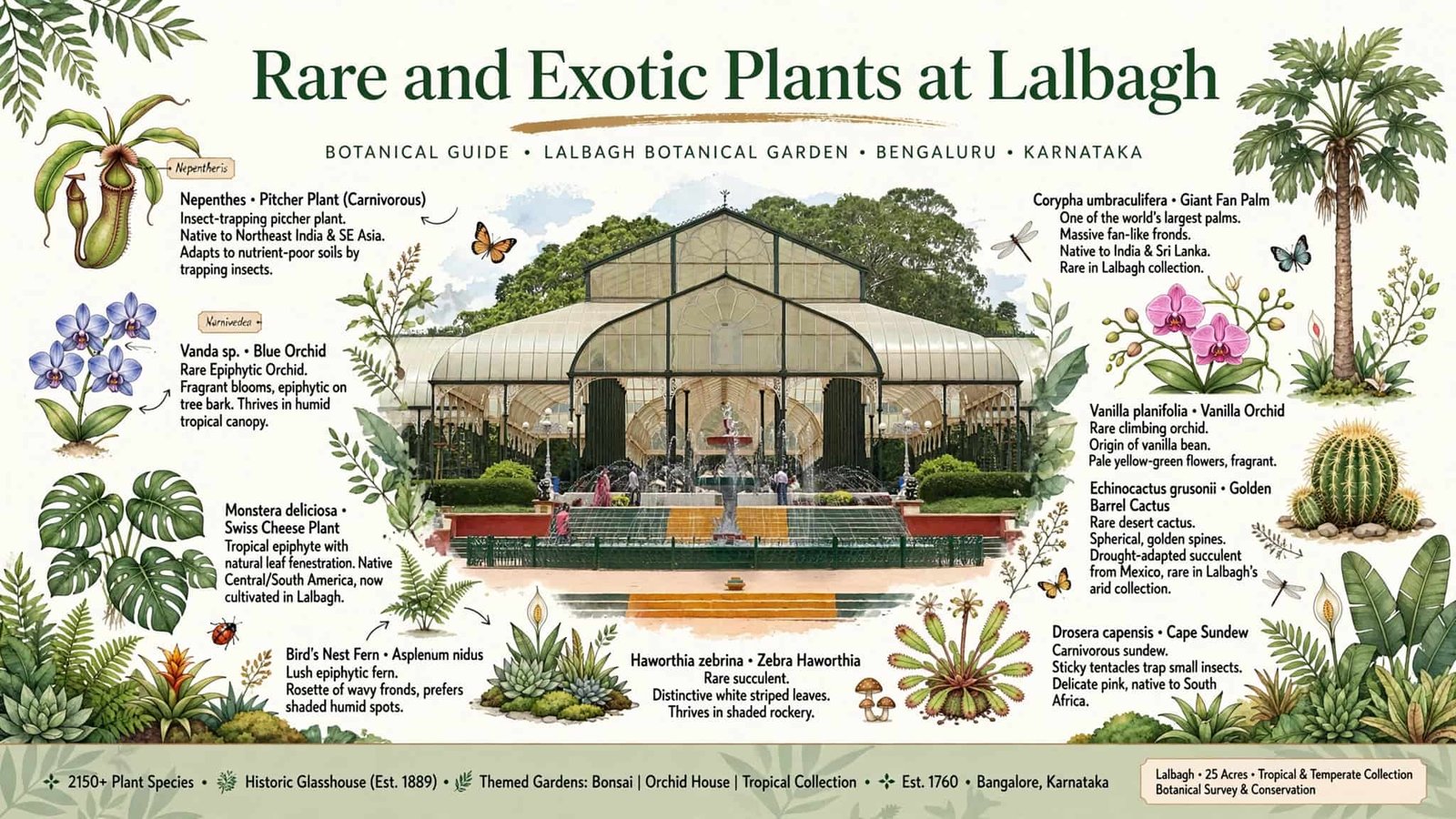
Lalbagh Botanical Garden in Bengaluru is much more than a landscaped city park. Spread across about 240 acres, it is a historic botanical garden known for its extensive collection of native and exotic plants. Karnataka Tourism currently describes Lalbagh as home to more than 1,854 plant species, while historical botanical records document the garden’s long tradition of introducing, acclimatizing and propagating plants collected from different parts of the world.
For plant enthusiasts, one of the most interesting things about Lalbagh is the opportunity to see unusual trees, palms, cycads, flowering plants and other botanical specimens that are not commonly encountered in ordinary urban gardens.
In this guide, we look at some of the notable rare and exotic plants associated with Lalbagh, what makes them interesting, and why the garden’s botanical collection is important.
What Makes Lalbagh’s Plant Collection Special?
Lalbagh’s botanical importance comes from its long history of plant introduction and acclimatization. The garden was started during the reign of Hyder Ali in 1760 and was subsequently developed by Tipu Sultan. Later horticultural administrators expanded its plant collections and introduced species from different parts of the world.
Historical botanical material records approximately 673 genera and 1,854 species in the garden’s collection. The documented exotic plants include species belonging to genera such as Agathis, Araucaria, Amherstia, Brownea, Castanospermum, Corypha, Magnolia and Swietenia.
It is worth noting that the term “rare” can be used differently. A plant may be uncommon in everyday gardens without being officially threatened or endangered. Therefore, the plants discussed below are best understood as notable, unusual or historically important specimens in Lalbagh’s botanical collection, rather than all being endangered species.
Notable Rare and Exotic Plants at Lalbagh
1. Amherstia nobilis – Pride of Burma

One of the most remarkable names in Lalbagh’s historical list of exotic plants is Amherstia nobilis, commonly known as the Pride of Burma.
The tree is famous for its elegant hanging flower clusters. Its flowers can have a combination of red, pink and yellow tones, making it a highly ornamental tropical tree.
The species is native to Myanmar and is known in horticulture for its attractive flowers and relatively limited cultivation compared with more common ornamental trees.
Its inclusion in Lalbagh’s documented exotic collection demonstrates the garden’s historical role in bringing plants from outside India into cultivation and study.
Why it is notable:
- Beautiful tropical flowers
- Uncommon ornamental tree
- Part of Lalbagh’s documented exotic plant heritage
2. Araucaria – Distinctive Conifer-Like Trees

The tall, symmetrical Araucaria trees are among the plants that can give parts of Lalbagh a distinctly different appearance.
Araucaria is a genus of ancient coniferous trees found naturally in parts of the Southern Hemisphere. Several species have become popular ornamental trees in gardens around the world.
Historical Lalbagh records specifically mention Araucaria species among the exotic plants introduced into the garden.
Their tall trunks and regularly arranged branches make them particularly noticeable when viewed against Bengaluru’s skyline.
Why it is notable:
- Unusual architectural growth form
- Represents an exotic conifer group
- Historically associated with Lalbagh’s international plant collection
3. Agathis Species
Agathis is another interesting genus included in historical records of Lalbagh’s exotic plant collection.
Members of the genus are large evergreen conifers naturally associated with regions of the Southern Hemisphere, particularly Australasia and the Pacific.
Unlike the flowering plants that attract immediate attention during flower shows, trees such as Agathis demonstrate another side of Lalbagh’s collection—the preservation and cultivation of unusual woody plants.
Historical botanical documentation lists Agathis sp. among the exotic plants introduced to Lalbagh.
4. Castanospermum australe – Moreton Bay Chestnut
Another fascinating species recorded among Lalbagh’s exotic plants is Castanospermum australe, commonly known as the Moreton Bay chestnut or blackbean.
It is native to eastern Australia and is known for its large seeds and attractive foliage. The tree belongs to the legume family and can become a substantial evergreen tree under suitable conditions.
Its presence in Lalbagh reflects the garden’s historical interest in plants from regions far beyond the Indian subcontinent.
Interesting fact: The species is particularly recognizable for its large, bean-like seeds, which have contributed to its common name.
5. Corypha umbraculifera – Talipot Palm

The Talipot palm (Corypha umbraculifera) is one of the spectacular palms associated with the botanical heritage of South India.
It is a giant fan palm capable of producing an enormous flowering structure. One of its most unusual characteristics is its monocarpic life cycle: after reaching maturity and producing its massive flowering structure and fruits, the palm eventually dies.
The species is included in historical records of Lalbagh’s exotic plant collection.
Because of its size and unusual life cycle, the Talipot palm is an especially interesting plant for visitors interested in palm diversity.
6. Magnolia Species
Magnolia is another internationally familiar genus represented in Lalbagh’s historical plant records.
Magnolias are known for their large, attractive flowers and glossy foliage. Many species originate in Asia and the Americas, and different magnolias are cultivated as ornamental trees in botanical gardens.
The presence of Magnolia in Lalbagh demonstrates the garden’s role in maintaining plant diversity beyond species traditionally associated with India’s tropical landscape.
7. Brownea grandiceps – Scarlet Flame Bean
Brownea grandiceps is another exotic flowering tree documented in Lalbagh’s plant collection.
Native to tropical South America, the tree is known for its striking clusters of flowers. Its young foliage can also be visually interesting, adding to its value as an ornamental tropical tree.
For visitors who are accustomed to seeing common flowering trees such as gulmohar, the Brownea genus offers a very different floral form.
8. Swietenia mahagoni – West Indian Mahogany

Swietenia mahagoni, commonly called West Indian mahogany, is another exotic species listed in historical records of Lalbagh.
Mahogany trees are internationally important timber trees, and the species is native to the Caribbean and parts of the Americas.
Its inclusion illustrates that Lalbagh’s botanical collection has never been limited to ornamental flowers. The garden has historically included ornamental, economic and scientifically interesting plants from different parts of the world.
9. Cola acuminata
Another unusual species listed in historical Lalbagh records is Cola acuminata.
The species belongs to the same genus associated with kola nuts and is native to tropical Africa. Plants from the Cola genus are particularly interesting from a botanical and economic perspective because of their historical cultural and commercial uses.
Seeing such species represented in a historic Indian botanical garden provides an example of how Lalbagh’s collection extends into plants with economic as well as ornamental importance.
10. Eriobotrya japonica – Japanese Loquat
Eriobotrya japonica, commonly known as the Japanese loquat, is another exotic species documented in Lalbagh’s plant collection.
It is an evergreen fruit tree originally associated with southeastern China and is now cultivated in many parts of the world.
The species demonstrates an important feature of botanical gardens: plants are not collected simply because they look unusual. Some are also valuable for understanding fruit crops, horticulture and plant adaptation.
Cycads and Bonsai: Another Interesting Side of Lalbagh

Visitors interested in unusual plants should also look at Lalbagh’s bonsai and cycad collections.
A documented Lalbagh specimen of Cycas revoluta has been photographed as a bonsai, demonstrating how the species can be trained into a miniature form.
Cycads are especially interesting because they are ancient seed plants that can resemble palms while belonging to a completely different plant group.
The bonsai section adds another dimension to Lalbagh’s horticultural collection, showing how trees and shrubs can be cultivated and trained into miniature forms.
Lalbagh’s Collection Goes Beyond Exotic Plants
It would be a mistake to think of Lalbagh only as a collection of imported species.
The garden also contains many native Indian trees and plants, including species documented in botanical records such as:
- Artocarpus heterophyllus – Jackfruit
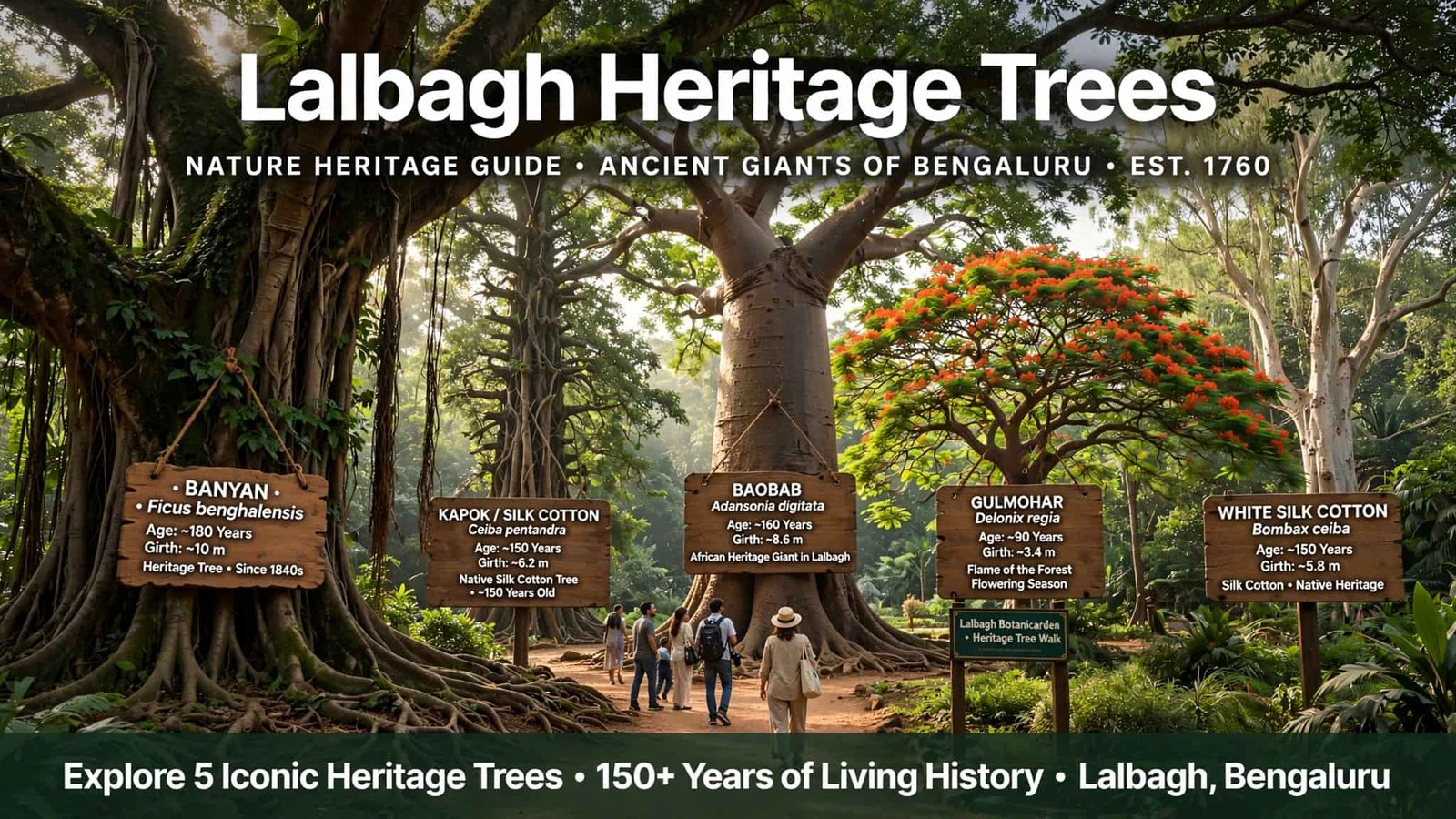
- Bombax ceiba – Silk Cotton
- Butea monosperma – Flame of the Forest
- Cassia fistula – Indian Laburnum
- Dillenia indica – Elephant Apple
- Ficus species
- Lagerstroemia speciosa – Queen’s Crape Myrtle
- Mesua ferrea – Ceylon Ironwood
These native species exist alongside plants introduced from other parts of the world.
This combination is one reason Lalbagh is more accurately understood as a botanical collection and living plant heritage site, rather than simply a decorative garden.
Why Does Lalbagh Have So Many Exotic Plants?
The answer goes back to the garden’s history.
Plant introduction became an important part of Lalbagh’s development, particularly during the 19th century. John Cameron, who became superintendent of Lalbagh in 1874, is credited by the horticulture department with systematic expansion and the introduction of numerous native and exotic species.
Plants were introduced from different geographical regions and then cultivated under Bengaluru’s conditions.
Over time, this created a living collection containing plants from India, Asia, Africa, Australia, the Americas and other parts of the world.
The garden’s role therefore extends beyond recreation. Karnataka Tourism describes Lalbagh as a centre for botanical research, horticulture education and conservation.
How Lalbagh Helps Preserve Plant Diversity
Botanical gardens can play several roles in plant conservation:
1. Living collections
Plants can be maintained as living specimens so visitors, students and researchers can study them.
2. Plant identification and documentation
Lalbagh has also been working toward better digital documentation of its plant wealth. A 2024 report noted that the horticulture department was developing a digital database containing information about individual plant species, including characteristics such as leaves, stems, flowers and fruits.
3. Horticultural education
The garden provides opportunities to observe different plant forms, cultivation methods and landscaping techniques.
4. Conservation
Some unusual plants can be maintained in controlled horticultural settings even when they are not commonly grown in ordinary urban landscapes.
Best Way to Explore the Rare Plants at Lalbagh
If your main purpose is to explore Lalbagh’s botanical diversity rather than simply take a morning walk, give yourself enough time to move beyond the most popular attractions.
Look carefully at:
- Large old trees and unusual tree forms
- Palm and cycad specimens
- Bonsai collections
- Flowering plant displays
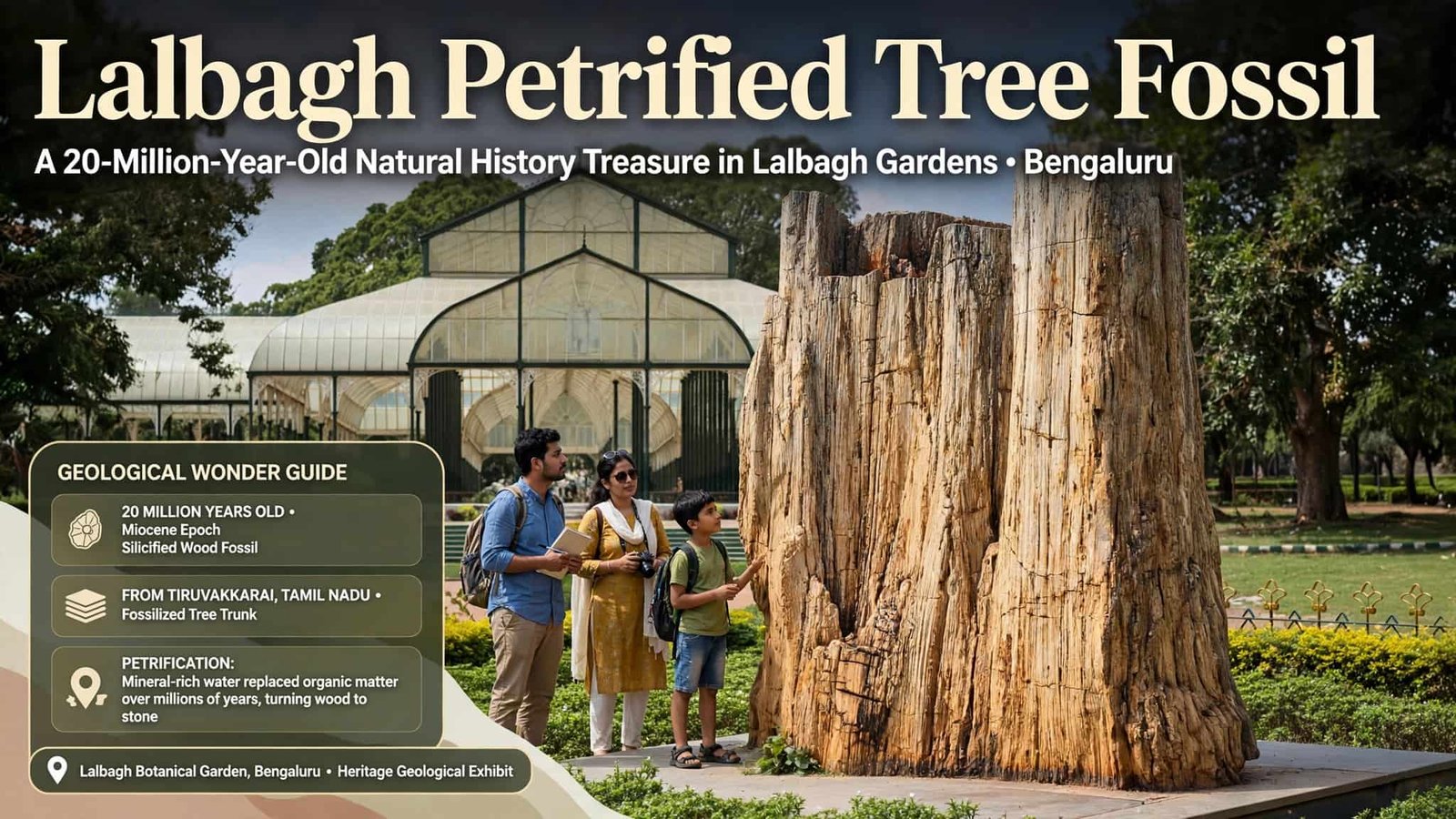
- Plants around the Glass House
- Special horticultural displays during flower shows
- Plant labels and identification boards
- Nursery and horticultural areas

The Glass House is particularly important during Lalbagh’s famous seasonal flower shows, when large horticultural displays bring together numerous ornamental plants and floral arrangements.
Are All Rare Plants at Lalbagh Endangered?
No.
This is an important distinction.
The phrase “rare plant” can mean a plant that is:
- uncommon in everyday gardens,
- difficult to find in a particular region,
- historically unusual in cultivation,
- represented by an interesting specimen,
- or genuinely threatened in the wild.
These are not the same thing.
Therefore, a plant being described as rare or exotic at Lalbagh does not automatically mean that it is endangered. Conservation status should be checked separately for each species using authoritative botanical or conservation databases.
Why Plant Lovers Should Visit Lalbagh
Lalbagh offers something that ordinary city parks cannot easily provide: a chance to observe plants as a living botanical collection.
Its importance comes from the combination of:
- centuries of horticultural history,
- native Indian plants,
- exotic introductions,
- mature heritage trees,
- palms and cycads,
- flowering plants,
- bonsai,
- horticultural experimentation,
- plant documentation and research.
The garden’s documented collection of more than 1,854 plant species gives visitors an idea of the botanical diversity contained within the 240-acre landscape.
For someone interested in plants, the most rewarding visit may not be about finding one particular “rare” flower. Instead, it is about noticing how many different plant groups have been brought together and maintained in one historic botanical garden.
Frequently Asked Questions
What are some exotic plants found at Lalbagh?
Historical records list exotic plants and genera including Amherstia nobilis, Araucaria, Agathis, Brownea grandiceps, Castanospermum australe, Corypha umbraculifera, Magnolia, Swietenia mahagoni, Cola acuminata and Eriobotrya japonica.
How many plant species are found in Lalbagh?
Karnataka Tourism currently states that Lalbagh is home to more than 1,854 plant species. Historical botanical documentation also records approximately 673 genera and 1,854 species.
Does Lalbagh have rare plants?
Yes. Lalbagh has a long-established collection of unusual and exotic plants from different parts of the world. However, “rare” does not necessarily mean endangered; conservation status varies by species.
Does Lalbagh have exotic trees?
Yes. The garden’s documented exotic collection includes trees belonging to genera such as Araucaria, Agathis, Amherstia, Brownea, Castanospermum, Magnolia and Swietenia.
Why is Lalbagh important for botany?
Lalbagh functions as more than a public garden. Its plant collections, horticultural activities, research, education and conservation work have made it an important botanical institution in Bengaluru.
Final Thoughts
Lalbagh Botanical Garden’s rare and exotic plants are an important part of Bengaluru’s botanical heritage. From unusual flowering trees such as Amherstia nobilis to distinctive Araucaria, cycads, palms and other exotic species, the garden reflects centuries of plant introduction, cultivation and horticultural experimentation.
What makes Lalbagh particularly interesting is the mixture of native Indian flora and plants introduced from around the world. A visit can therefore be both a relaxing garden walk and an opportunity to explore a remarkable living collection of plant diversity.

Suresh Kumar is the founder and editor of LalbaghBotanicalGarden.com, a website dedicated to helping visitors plan their trips to Lalbagh Botanical Garden with accurate, well-researched information on timings, fees, history, and attractions. Content is compiled and fact-checked using official sources and government tourism records.
Email: lalbaghgardenbangalore@gmail.com