









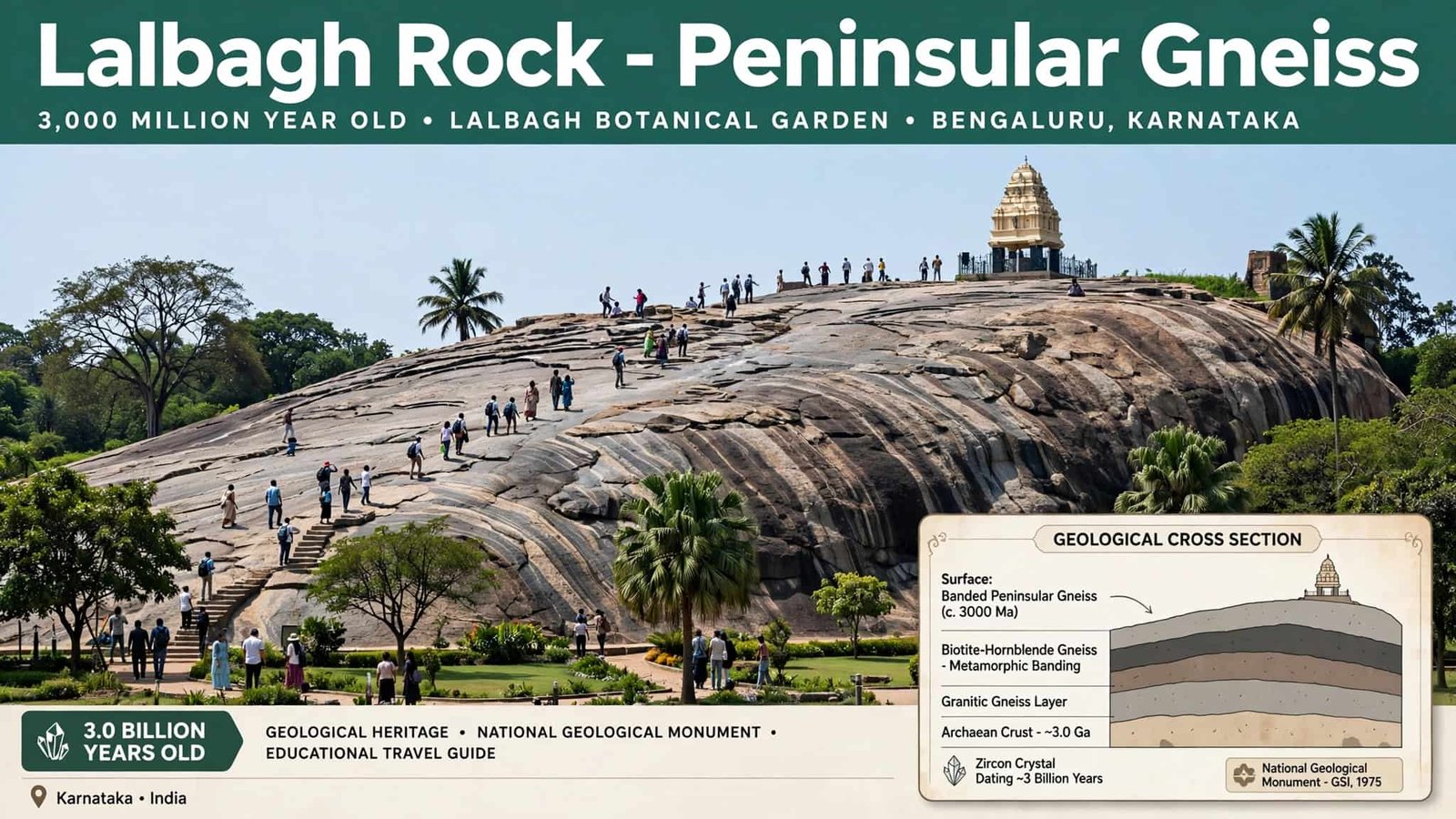
Among the flowers, lawns and carefully maintained gardens of Lalbagh, there is one feature that belongs to a completely different chapter of Earth’s history.
It is Lalbagh Rock, the large rocky outcrop commonly identified as Peninsular Gneiss.
The garden itself dates back to the 18th century, but the rock is unimaginably older. Tourism sources describe the formation as being more than 3,000 million years old, placing it among the ancient geological features associated with Bengaluru. The site is also described as a protected geological monument.
That contrast is what makes the rock particularly interesting: visitors can move from a historic botanical garden to a piece of Earth’s deep geological past within the same walk.
What Is Lalbagh Rock?
Lalbagh Rock is a prominent rocky outcrop within Lalbagh Botanical Garden.
It is commonly referred to as Peninsular Gneiss, a term used for a group of very old crystalline rocks associated with the Indian Peninsula.
For a visitor, the most striking fact is its age.
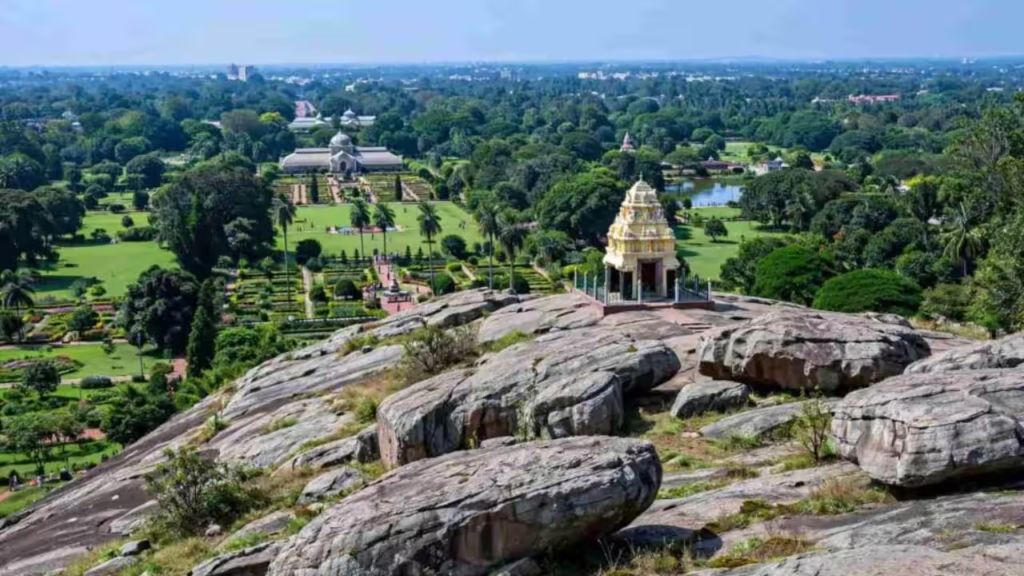
Karnataka Tourism and Incredible India place the age of the geological formation at roughly 3 billion years or more.
To put that into perspective, the garden’s human history is measured in centuries, while the rock’s geological history is measured in billions of years.
That makes Lalbagh an unusual place where natural and human history overlap.
Why Is Peninsular Gneiss Important?
Gneiss is a type of metamorphic rock. It develops when pre-existing rocks undergo intense heat and pressure over very long periods.
Peninsular Gneiss is particularly important in the geological history of southern India because formations of this kind preserve evidence of some of the ancient rocks that make up the Indian subcontinent.
The Lalbagh outcrop is therefore not simply an attractive rocky hill inside a garden.
It represents a geological record that predates the city of Bengaluru, the modern landscape and even much of the biological world familiar to us today.
This is why the rock is treated as a geological heritage feature rather than merely another viewpoint.
How Old Is Lalbagh Rock?
You will often see the figure 3,000 million years associated with Lalbagh Rock.
Karnataka Tourism’s current Lalbagh page describes the rock formation as more than 3,000 million years old, while Incredible India also describes the geological formation as approximately 3,000 million years old.
It is worth writing the age this way rather than turning it into a false precision such as “3,012,345,678 years old.”
Geological ages are generally estimates based on scientific dating and interpretation of rock formations.
For a visitor, the meaningful point is simple: the rock is measured in billions of years, not thousands or millions of years.
The Kempegowda Watchtower on the Rock
The geological importance of Lalbagh Rock is only half of the story.
Standing on the rocky outcrop is a historic Kempegowda watchtower.
According to Karnataka Tourism and Incredible India, Kempegowda I constructed four watchtowers around Bengaluru to indicate the boundaries of the city he had founded or envisioned. The Lalbagh tower is one of those historic landmarks.
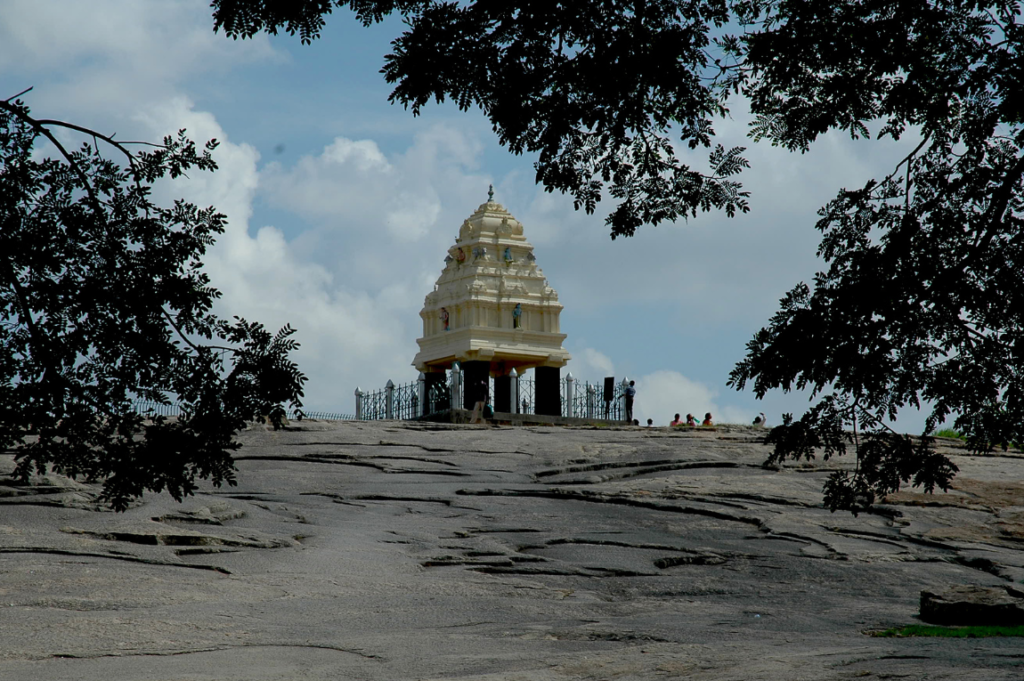
This creates an unusual layering of history:
Ancient rock → historic Bengaluru → modern botanical garden.
The rock existed billions of years before Bengaluru was established. Centuries later, the watchtower became part of the city’s early history. Much later, the surrounding land became part of the large botanical garden visitors know today.
That is why the tower and rock are often discussed together, even though they represent completely different kinds of heritage.
Is Lalbagh Rock a National Geological Monument?
Official tourism material identifies the rock as a protected geological monument and refers to the National Geological Monument designation.
For visitors, this status is more than a label.
A geological heritage site cannot be treated like an ordinary piece of landscaping. Its value comes from the natural formation itself, and the appropriate way to experience it is to observe the rock without attempting to damage, carve or remove pieces of it.
What Can Visitors Actually See?
The rock is not presented like a museum exhibit with dozens of information panels.
Its appeal is largely physical.
You can see the exposed rock surface, the shape of the outcrop and the elevated position of the watchtower. The surrounding garden creates an interesting contrast because greenery, landscaped paths and old trees sit around a geological formation that is vastly older than everything else nearby.
If you are interested in photography, the elevated terrain can also give you a different perspective on the garden.
But the best reason to visit is not simply the view.
It is the scale of the story.
You are looking at something whose history stretches back billions of years.
Lalbagh Rock vs. Bengaluru’s Modern Landscape
One of the most interesting things about Lalbagh Rock is how much the surrounding environment has changed.
The watchtower was built when Bengaluru was a much smaller settlement. Today, the city extends far beyond the historical limits associated with Kempegowda’s towers.
The rock, however, remains where it has always been.
That makes it a useful physical reminder of how dramatically Bengaluru’s landscape has changed.
Modern roads, buildings, metro lines and neighbourhoods have grown around the garden, while the geological foundation beneath it is unimaginably older.
A Good Way to Explore the Rock
If you’re visiting Lalbagh specifically for its heritage, don’t treat the rock as just another stop on a checklist.
Look at the rock first as a geological feature.
Then look at the watchtower as a historical structure.
Finally, look outward and consider the contrast between the old boundary marker and today’s enormous Bengaluru.
That three-part view makes the attraction much more meaningful than simply taking a photograph and moving on.
Why Lalbagh Rock Is Different From Other Attractions
Lalbagh has many attractions, but they tell very different kinds of stories.
The Glass House represents architectural and horticultural history. The Bonsai Garden reflects the careful art of growing miniature trees. The lake is part of the garden’s landscape and ecological character.
Lalbagh Rock takes visitors much further back in time.
Its story is geological. The Peninsular Gneiss formation is estimated to be more than 3 billion years old, making it vastly older than the garden itself and the city that grew around it. The Kempegowda watchtower adds another layer of history to the same location.
That combination is what makes this part of Lalbagh particularly unusual: one location brings together Earth’s ancient geological history, Bengaluru’s early history and the later development of the botanical garden.
Read Also: Lalbagh Botanical Garden History: From Hyder Ali to Tipu Sultan

Suresh Kumar is the founder and editor of LalbaghBotanicalGarden.com, a website dedicated to helping visitors plan their trips to Lalbagh Botanical Garden with accurate, well-researched information on timings, fees, history, and attractions. Content is compiled and fact-checked using official sources and government tourism records.
Email: lalbaghgardenbangalore@gmail.com