










The small stone watchtower on the rocky outcrop inside Lalbagh may look modest compared with the garden’s Glass House.
Its historical importance, however, comes from what it represents.
The Kempegowda Watch Tower at Lalbagh is traditionally identified as one of the four towers associated with Kempegowda I, the founder of Bengaluru. The towers were used to mark the boundaries or extent of the city during its early development.
The Lalbagh tower is especially interesting because it stands on the ancient Peninsular Gneiss rock formation.
So one visit brings together two very different timelines: the geological age of the rock and the early urban history of Bengaluru.
Who Was Kempegowda?
Kempegowda I is closely associated with the foundation and early development of Bengaluru.
The city that exists today is vastly larger than the settlement of his time, but several historic structures and landmarks continue to preserve connections with that early period.

The watchtowers are among them.
In the context of Lalbagh, the tower provides a physical connection between the botanical garden and the older history of Bengaluru itself.
Why Were the Four Watchtowers Built?
The four towers are traditionally associated with the four cardinal directions around Bengaluru.
Their purpose is commonly described as marking the limits to which the city was expected to develop. Karnataka Tourism and Incredible India both describe the Lalbagh tower as one of four towers built by Kempegowda to mark the city’s boundaries.
Today, that idea can be difficult to imagine.
Bengaluru has grown far beyond those historical limits.
The towers therefore have a symbolic value that is different from their original practical role. They help visitors understand the scale of the early settlement compared with the modern metropolis surrounding it.
Why Is the Lalbagh Tower Special?
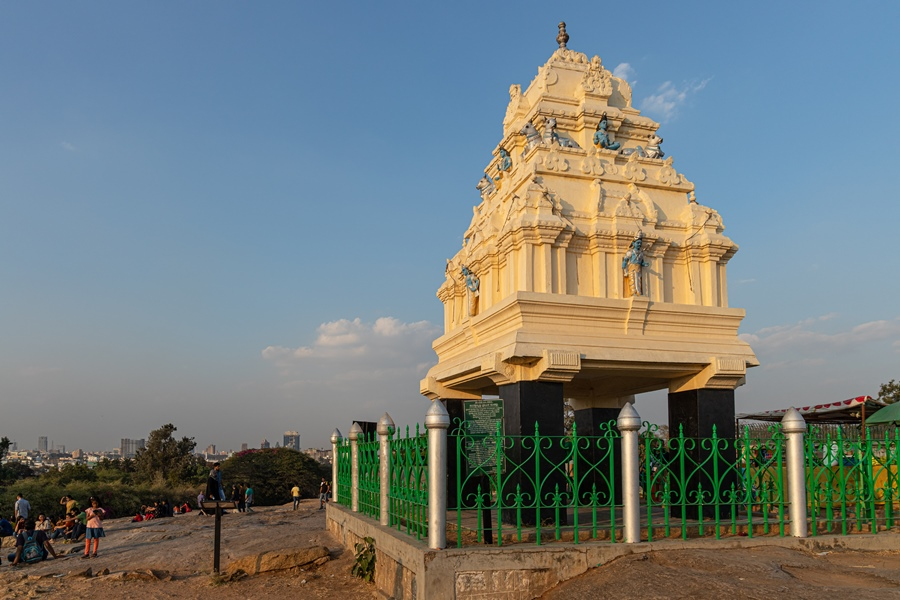
The Lalbagh tower is not standing on ordinary ground.
It is positioned on the Peninsular Gneiss rock formation, which is estimated to be more than 3 billion years old.
That creates an extraordinary combination:
- Ancient geological heritage — the rock
- 16th-century Bengaluru history — the watchtower
- 18th-century horticultural history — Lalbagh
- Modern Bengaluru — the city visible beyond the garden
Few individual locations inside the city bring these timelines together so clearly.
The Tower and Lalbagh Are Not From the Same Period
This is an important point that often gets lost in simplified descriptions.
Lalbagh’s botanical garden was commissioned under Hyder Ali in 1760, while the Kempegowda towers belong to an earlier period associated with the foundation of Bengaluru.
So the watchtower was not originally constructed as part of Lalbagh Botanical Garden.
Rather, the garden developed around a landscape that already contained this historic landmark.
That distinction makes the story more interesting.
The tower was already connected with Bengaluru’s early history before Lalbagh became the major botanical garden it is today.
The View from the Watchtower
Because the tower stands on an elevated rocky outcrop, it has long been associated with a viewpoint over the surrounding area.
Today, the view is obviously very different from what it would have been centuries ago.
Instead of looking toward the edge of a small settlement, visitors are surrounded by the dense urban landscape of Bengaluru.
That difference itself is historically valuable.
Standing there allows you to see, quite literally, how far the city has expanded beyond its early boundaries.
The Ancient Rock Beneath the Tower
The geological story deserves attention because it is easy to overlook.
The Peninsular Gneiss rock at Lalbagh is described by official tourism sources as being more than 3,000 million years old. It is one of the reasons Lalbagh is significant not only as a garden but also as a place of geological heritage.
The rock and tower should therefore be understood separately:
The rock is a natural geological formation.
The tower is a human-made historical structure.
One predates human civilization by billions of years; the other belongs to the historical development of Bengaluru.
Putting them together is what makes the site so unusual.
What Visitors Should Notice
If you’re walking toward the tower, don’t focus only on reaching the top.
Look at the rocky terrain around it.
Then look at the construction of the tower.
Finally, look outward at the modern city.
The attraction becomes much more meaningful when these three elements are considered together.
For someone interested in Bengaluru history, this is one of the places inside Lalbagh where the garden’s identity as a historical landscape becomes particularly clear.
The Four Towers and Bengaluru Today
Modern Bengaluru has grown so extensively that the old boundary concept can be difficult to visualize.
The watchtowers provide a reference point.
They show that Bengaluru’s history did not begin as the huge urban region we see today. The city developed outward over centuries, while historical landmarks remained embedded within the changing landscape.
The Lalbagh tower is therefore more than a small old structure.
It is a surviving marker of an earlier Bengaluru.
Why the Kempegowda Watch Tower Is Important
The Lalbagh watchtower offers a small but meaningful connection to Bengaluru’s early history. Its location on the ancient rocky outcrop makes the site even more unusual, bringing together the story of Kempegowda’s Bengaluru with a geological formation that is billions of years old.
For visitors exploring Lalbagh, the tower is worth seeing not simply as an old structure, but as a reminder of how different layers of Bengaluru’s history exist within the same landscape.
Also Check: Lalbagh Rock: Peninsular Gneiss, Geological History & Significance

Suresh Kumar is the founder and editor of LalbaghBotanicalGarden.com, a website dedicated to helping visitors plan their trips to Lalbagh Botanical Garden with accurate, well-researched information on timings, fees, history, and attractions. Content is compiled and fact-checked using official sources and government tourism records.
Email: lalbaghgardenbangalore@gmail.com