







The Lalbagh Bandstand is one of the lesser-known heritage structures inside Lalbagh Botanical Garden in Bengaluru. While the Glass House and Lalbagh Rock usually receive most of the attention, the Bandstand has its own fascinating story connected with the development of the garden, early flower shows, public entertainment and Bengaluru’s colonial-era landscape.
The pavilion has also undergone restoration over the years. Its present appearance reflects both its historic design and later conservation work, making it an interesting example of how Bengaluru has tried to preserve its garden heritage.
What Is the Lalbagh Bandstand?
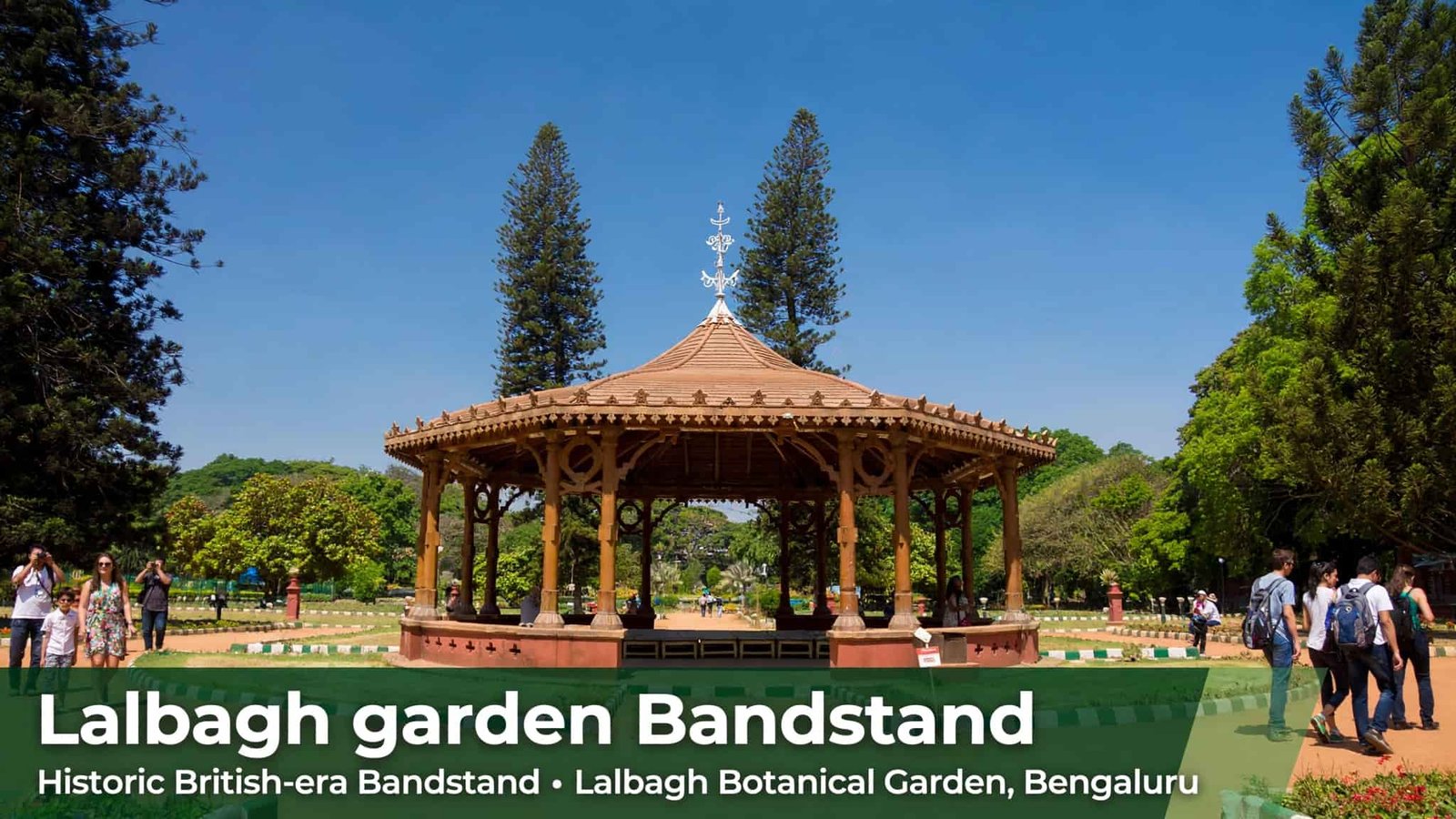
The Lalbagh Bandstand is a pavilion-like structure located in the historic central area of Lalbagh Botanical Garden, close to the Glass House.
Traditionally, a bandstand was an open pavilion where musical bands could perform for visitors in a park or public garden. During the colonial period, such structures became common in gardens and recreational spaces across India.
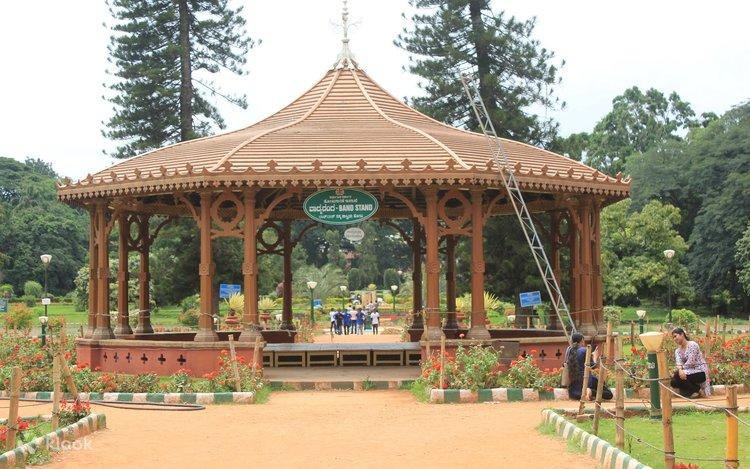
The Lalbagh Bandstand served a broader purpose than music alone. Historical accounts connect the area around the Bandstand with some of Lalbagh’s earliest flower shows, before the famous Glass House became the principal venue for these exhibitions.
Today, the structure is valued primarily as a heritage feature of Lalbagh and as part of the garden’s historic landscape.
History of Lalbagh Bandstand
The history of the Bandstand goes back to the 19th century, when Lalbagh was being developed into an important botanical and horticultural institution.
There are slightly different dates in historical accounts. A detailed historical account of Lalbagh identifies the Bandstand as having been built in 1867 by MacFarlane and Company of Glasgow, while other accounts place its development or early use in the 1860s and 1870s.
This difference is worth mentioning because the structure went through repairs, alterations and later reconstruction, making a single “construction year” difficult to establish from every historical source.
The Bandstand and Early Flower Shows
One of the most important aspects of the Bandstand’s history is its relationship with Lalbagh’s early flower exhibitions.
Before the present Glass House was completed in 1890, flower shows were held around the Bandstand. The first exhibitions were associated with the development of horticulture at Lalbagh and the efforts of its British-trained horticultural superintendents to encourage the cultivation of flowers, fruits and vegetables.
This gives the Bandstand an important place in the history of Bengaluru’s famous flower-show tradition.
The Glass House later became the principal location for major flower exhibitions, but the Bandstand remained an important landmark within the garden.
Who Built the Lalbagh Bandstand?
Historical sources attribute the original Bandstand to MacFarlane and Company of Glasgow, Scotland. The company was well known for ornamental architectural and cast-iron work during the Victorian period.
However, visitors should distinguish between the 19th-century historic Bandstand and the structure that has stood in more recent decades.
The Bandstand deteriorated over time and underwent substantial rebuilding/restoration. During the early 2000s, craftsmen from Kerala were involved in reconstructing the structure using traditional woodworking techniques while attempting to retain its historic appearance. A 2003 report described the use of seasoned teak and the traditional arukuduma method of joining wooden components.
Therefore, the Bandstand seen by modern visitors is best understood as a heritage structure whose present form incorporates later restoration and reconstruction work, rather than assuming that every visible component is original to the 19th century.
Architecture of Lalbagh Bandstand

The Bandstand stands out because of its open pavilion design and decorative detailing.
1. Open-Sided Pavilion
The structure is designed as an open pavilion rather than an enclosed building. This was practical for a bandstand because music could travel freely into the surrounding garden.
Its open sides also allow visitors to view the surrounding lawns, flower beds and pathways.
2. Decorative Wooden Structure
The present structure features elaborately shaped wooden columns, brackets and decorative elements.
The reconstruction work in the early 2000s used traditional woodworking techniques. Contemporary reporting described craftsmen joining wooden pieces into larger structural components without relying on conventional nails and screws in the same manner as modern construction.
3. Sloping Roof
One of the most noticeable features is its large, sloping roof.
The roof protects the open pavilion from Bengaluru’s sun and rain while also giving the structure its distinctive silhouette. The decorative roofline and central finial add to its ornamental appearance.
4. Raised Platform
The Bandstand is positioned on a raised base, creating a clear distinction between the performance area and the surrounding garden.
Historical accounts also mention a granite platform associated with later improvements to the Bandstand.
5. Relationship With the Garden
Perhaps the most important architectural characteristic of the Bandstand is its relationship with the surrounding landscape.
Unlike a standalone monument, it was designed as part of a garden environment. Flower beds, lawns, mature trees and pathways form its immediate setting.
This combination of architecture and horticultural landscape is an important part of its visual appeal.
Lalbagh Bandstand and Bengaluru’s Music Culture
Bandstands became popular in British-era public gardens because they provided a dedicated place for outdoor musical performances.
Historical accounts of Bengaluru describe military and other bands performing in public parks and garden spaces. The Lalbagh Bandstand was part of this broader tradition.
A 2003 historical report notes that the earlier Bandstand was associated with regular performances by the police band, with music being played there for more than a century.
The Bandstand therefore represents more than just garden architecture. It reflects an earlier period when public gardens served as important social and entertainment spaces.
Why Is Lalbagh Bandstand Significant?
There are several reasons why the Bandstand remains important today.
Connection With Lalbagh’s Horticultural History
The Bandstand was associated with early flower shows before the Glass House became the main exhibition venue. This links the structure directly with Lalbagh’s long horticultural tradition.
Example of Colonial-Era Garden Architecture
The Bandstand represents the type of ornamental garden architecture that became popular in British-era India.
Its design combines a functional purpose with decorative detailing, allowing the structure to serve both as a performance platform and a visual feature within the garden.
Part of Bengaluru’s Cultural History
For generations, Lalbagh has been more than a botanical garden. It has been a place for walks, exhibitions, performances, celebrations and public gatherings.
The Bandstand is a physical reminder of this changing social role.
Heritage Value
The structure is also significant because Lalbagh contains layers of history from different periods, including the garden’s origins under Hyder Ali and Tipu Sultan, its later development under the Mysore state and its transformation into a major botanical institution.
The Bandstand belongs primarily to the later 19th-century chapter of this history.
Restoration of the Lalbagh Bandstand
The Bandstand has faced deterioration caused by age, weather and exposure.
In 2003, major reconstruction work was undertaken after the older structure had deteriorated. Craftsmen from Kerala were brought in and traditional woodworking methods were used to recreate the structure’s historic appearance.
The structure again faced serious conservation problems in the 2020s.
By 2024, reports described portions of the Bandstand as being in poor condition, with temporary supports being used after structural deterioration.
In 2025, the structure was dismantled for conservation work. INTACH reported that its wooden components were being carefully numbered so that usable timber could be salvaged and reused, while structural experts worked on the restoration approach.
A 2025 heritage report also noted that the major problem involved the roof and weakened wooden members, including damage caused by water ingress.
In January 2026, reports indicated that the Karnataka horticulture authorities were considering further renovation work for the Bandstand, including a proposed reconstruction using modern structural technology while retaining its heritage appearance.
Because restoration plans can change, visitors should check the latest information from the Lalbagh/Horticulture Department before planning specifically to see the Bandstand.
Lalbagh Bandstand vs. Lalbagh Glass House
The Bandstand and Glass House are often seen together, but they have different historical purposes.
| Feature | Lalbagh Bandstand | Lalbagh Glass House |
|---|---|---|
| Main purpose | Music, public gatherings and garden events | Flower exhibitions and horticultural displays |
| Historical period | 19th century | Completed in 1890 |
| Design | Open pavilion | Large glass-and-iron conservatory |
| Connection to flower shows | Early shows were held around it | Later became the main flower-show venue |
| Present importance | Heritage garden structure | Major Lalbagh landmark and exhibition venue |
The two structures together illustrate how Lalbagh developed from a historic garden into a major public horticultural institution.
Where Is the Lalbagh Bandstand?
The Bandstand is located inside Lalbagh Botanical Garden in Bengaluru, Karnataka, in the central garden area near the Glass House.
Because Lalbagh covers a large area, visitors may encounter several attractions during the same walk. The Bandstand can conveniently be combined with the Glass House, flower beds and other historic features of the garden.

Best Time to See the Bandstand
The Bandstand can be appreciated throughout the year, but it is particularly attractive when the surrounding gardens are in bloom.
The area can become especially lively around Lalbagh’s Republic Day and Independence Day flower shows, although the main exhibitions are held in and around the Glass House today.
For photography, early morning and late afternoon generally provide softer natural light and a quieter garden atmosphere.
Interesting Facts About Lalbagh Bandstand
- The Bandstand dates back to the 19th-century development of Lalbagh.
- A detailed historical account dates the original structure to 1867 and attributes it to MacFarlane and Company of Glasgow.
- Early Lalbagh flower shows were held around the Bandstand before the Glass House was built.
- The Bandstand was associated with musical performances in Lalbagh.
- Its later reconstruction used traditional woodworking techniques and seasoned teak.
- The structure has required repeated conservation because of weathering and age.
- In 2025, its wooden components were dismantled and numbered as part of conservation efforts.
- Its significance comes from the combination of architecture, horticulture, music and Bengaluru’s social history.
Why the Lalbagh Bandstand Matters Today
The Lalbagh Bandstand may not be as famous as the Glass House, but it tells a different part of Lalbagh’s story.
It represents a time when botanical gardens were not simply places to study plants. They were also spaces for music, exhibitions, social gatherings and public recreation.
Its connection with Lalbagh’s early flower shows makes it particularly interesting for anyone exploring the history of Bengaluru’s horticultural traditions. Its architecture also demonstrates how decorative structures were integrated into historic garden landscapes.
Most importantly, the Bandstand shows why heritage conservation is about more than preserving individual buildings. The surrounding trees, flower beds, pathways and historic structures together create the character of Lalbagh.
Frequently Asked Questions
When was the Lalbagh Bandstand built?
Historical sources differ slightly on the date, but a detailed history of Lalbagh dates the original Bandstand to 1867 and attributes it to MacFarlane and Company of Glasgow. Other accounts place its development in the broader 1860s–1870s period.
What was the Lalbagh Bandstand used for?
It was designed as a performance pavilion and was associated with musical performances. The area was also used for early flower shows before the construction of the Glass House.
Is the current Lalbagh Bandstand original?
The structure has undergone substantial reconstruction and restoration. The present timber structure incorporates later conservation/rebuilding work rather than consisting entirely of original 19th-century material.
What is the architectural style of the Bandstand?
It is an ornamental open-sided garden pavilion featuring decorative wooden elements, a prominent sloping roof and a raised platform. Its design reflects the bandstand tradition associated with colonial-era public gardens.
Is the Lalbagh Bandstand near the Glass House?
Yes. The Bandstand is located in the central area of Lalbagh and is close to the famous Glass House.
Is the Lalbagh Bandstand currently undergoing restoration?
The structure was dismantled for conservation work in 2025, and further renovation/reconstruction planning was reported in January 2026. The exact visitor access status can change during restoration, so checking current garden information before visiting is advisable.
See Also: Lalbagh Lake: History, Ecology and What to See

Suresh Kumar is the founder and editor of LalbaghBotanicalGarden.com, a website dedicated to helping visitors plan their trips to Lalbagh Botanical Garden with accurate, well-researched information on timings, fees, history, and attractions. Content is compiled and fact-checked using official sources and government tourism records.
Email: lalbaghgardenbangalore@gmail.com