







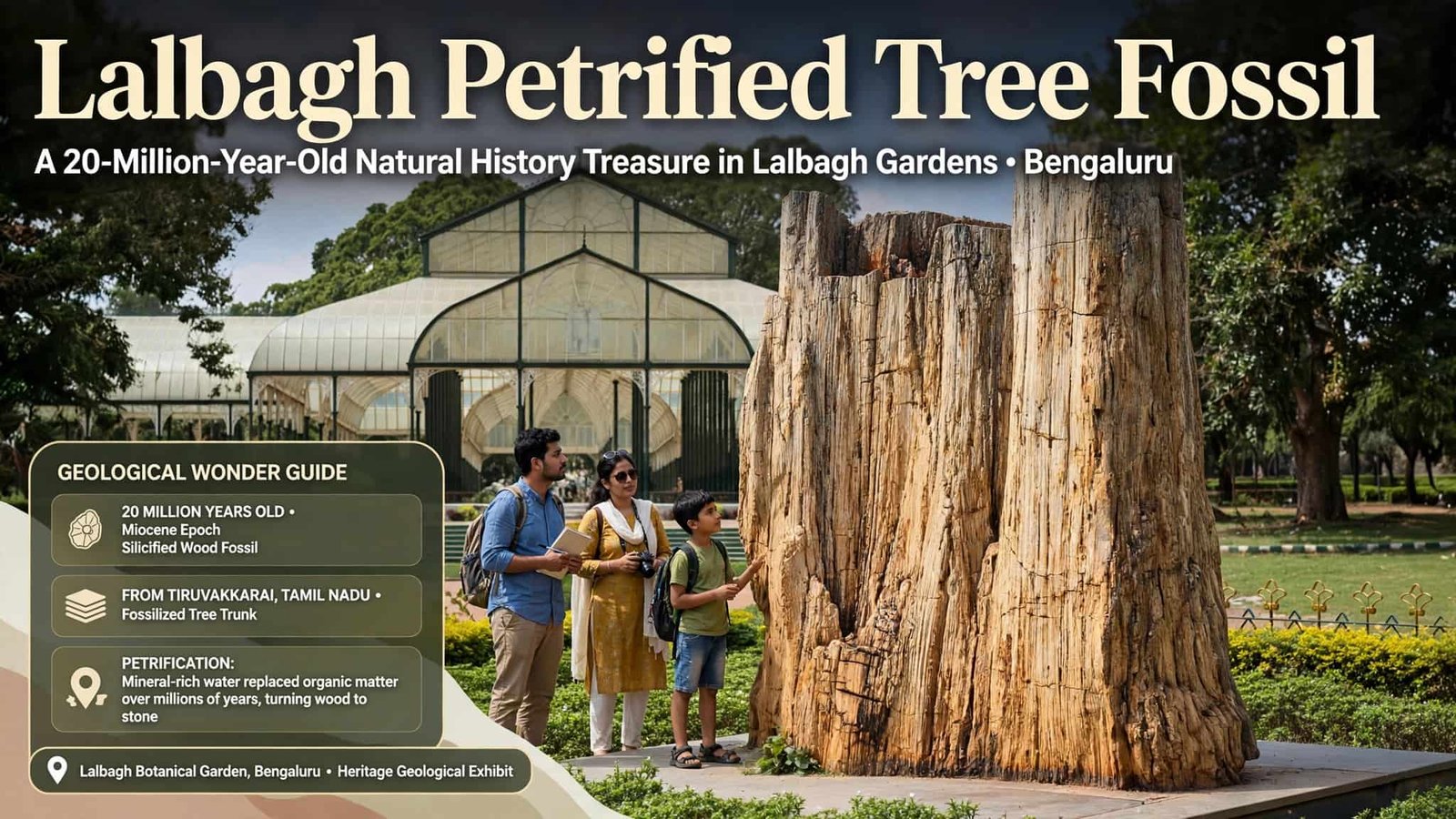
Hidden among the greenery of Lalbagh Botanical Garden in Bengaluru is an unusual attraction that is far older than the garden itself: a petrified tree fossil believed to be about 20 million years old.
Unlike the living trees surrounding it, this ancient trunk is no longer made of wood. Over geological time, the original organic material was replaced by minerals, preserving the shape and texture of the tree as stone.
The fossil was brought to Lalbagh from the National Fossil Park at Tiruvakkarai in Tamil Nadu. The display is particularly interesting because it adds a geological dimension to a garden otherwise known for its plants, historic Glass House, lake and famous Lalbagh Rock.
What Is the Lalbagh Petrified Tree Fossil?
The Lalbagh tree fossil is a petrified coniferous tree trunk. Information displayed about the specimen states that it was collected from the National Fossil Park at Tiruvakkarai in Tamil Nadu and is approximately 20 million years old.
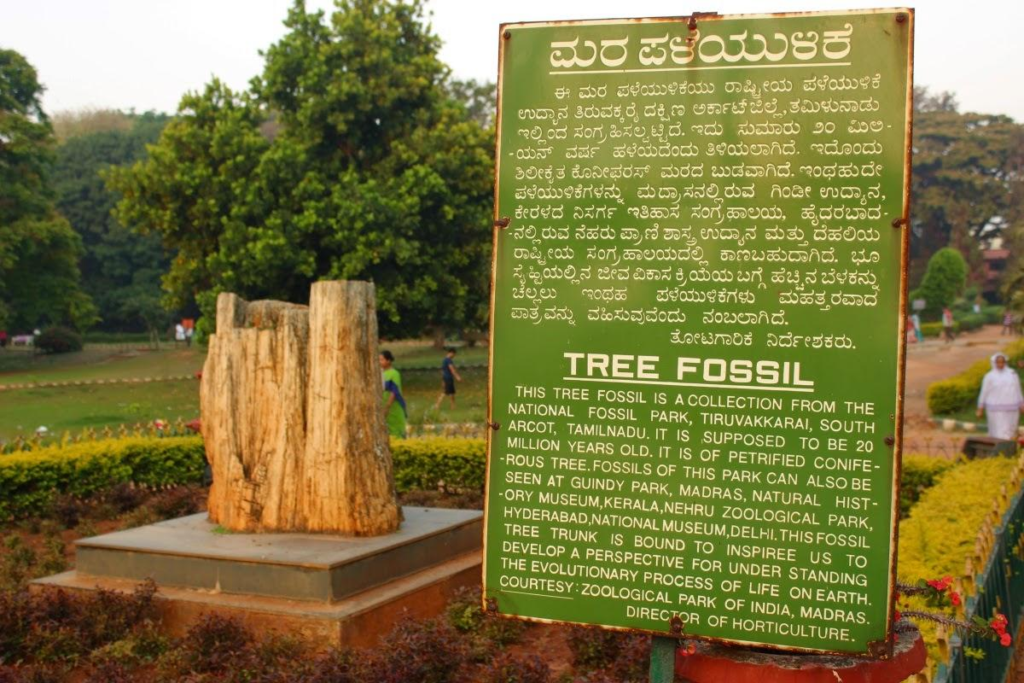
The word petrified means that the original wood underwent a long process of mineralization. As mineral-rich water moved through the buried wood, minerals gradually replaced the organic material while retaining much of the original structure.
That is why the specimen still looks remarkably like a tree trunk even though it has become stone.
Quick Facts
| Feature | Details |
|---|---|
| Attraction | Petrified Tree Fossil |
| Approximate age | 20 million years |
| Type | Petrified coniferous tree |
| Original location | Tiruvakkarai, Tamil Nadu |
| Displayed at | Lalbagh Botanical Garden, Bengaluru |
| Location inside Lalbagh | West of/near the Bandstand, toward the Topiary Garden |
| Geological significance | Example of fossilized ancient plant material |
The location between the Bandstand and Topiary Garden is documented in a study of Lalbagh’s history and attractions.
How Old Is the Lalbagh Tree Fossil?
The fossil is generally described as around 20 million years old.
That means the tree lived during a period vastly different from the modern landscape of Bengaluru. The fossil predates the establishment of Lalbagh by millions of years—the garden itself was begun under Hyder Ali around 1760.
It is important to distinguish this fossil from Lalbagh Rock, another major geological attraction in the garden. Lalbagh Rock is part of the ancient Peninsular Gneiss and is billions of years old, whereas the tree fossil is approximately 20 million years old.
Where Did the Fossil Come From?
The petrified tree at Lalbagh did not originally grow in Bengaluru.
The specimen was collected from Tiruvakkarai in Tamil Nadu, an area famous for its fossil wood. Government information lists fossil wood near Tiruvakkarai among India’s geo-heritage sites.
The information associated with the Lalbagh specimen identifies its source as the National Fossil Park, Tiruvakkarai, South Arcot, Tamil Nadu.
Today, the National Fossil Wood Park at Tiruvakkarai is associated with fossilized tree remains preserved in the region’s geological formations.
How Did the Tree Become a Fossil?
Petrification is a natural geological process that can preserve the structure of wood for millions of years.
A simplified sequence looks like this:
- The tree died and became buried under sediment.
- Burial protected much of the wood from normal decomposition.
- Mineral-rich water moved through the buried material.
- Minerals gradually filled spaces within the wood and replaced its organic components.
- Over an extremely long period, the original wood was transformed into a stone-like fossil.
- The detailed structure of the original tree remained preserved.
The fossil wood deposits around Tiruvakkarai are associated with ancient sediments. A Geological Survey of India information panel reproduced in a government training document explains that the tree trunks were transported by rivers and deposited in water bodies along with sediments around 20 million years ago.

What Does the Lalbagh Fossil Look Like?
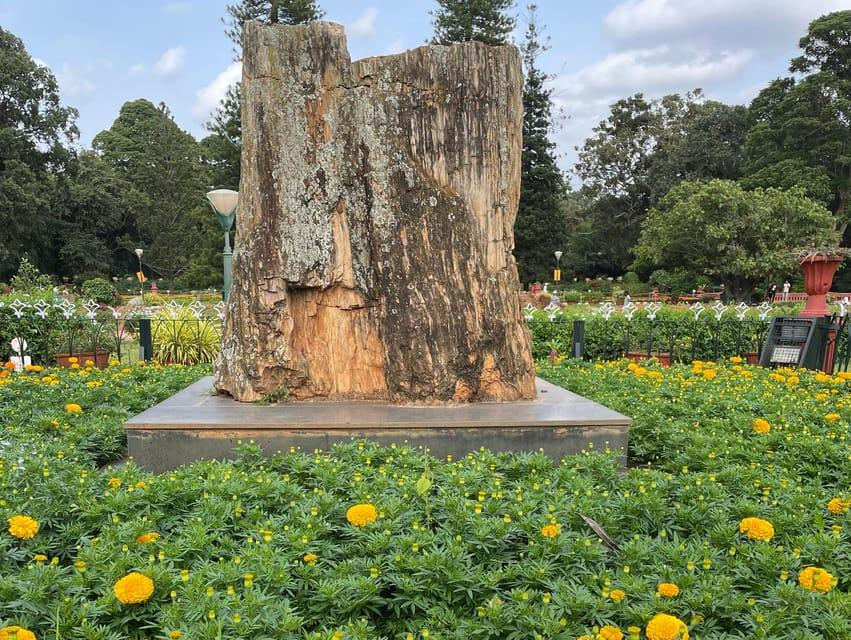
The fossil resembles a large, weathered tree stump rather than an ordinary piece of rock.
Its surface contains vertical textures, cracks, ridges and patterns that help reveal the form of the original trunk. Photographs of the Lalbagh specimen show it displayed vertically on a raised stone platform within the garden.
The contrast is especially striking: a piece of geological history millions of years old sits among flower beds, lawns and living trees in one of Bengaluru’s best-known botanical gardens.
Where Can You See the Petrified Tree Fossil in Lalbagh?
If you want to see the fossil during your visit, look for it in the area near the Bandstand and Topiary Garden.
Historical documentation of Lalbagh describes the fossil as being erected west of the Bandstand. A Lalbagh attraction guide also places the 20-million-year-old petrified coniferous fossil between the Bandstand and Topiary Garden.
Because Lalbagh is a large garden, it can be easy to walk past the fossil without noticing it. It is worth checking the garden’s current signboards or asking staff for directions once you enter.
Nearby Lalbagh Attractions
You can combine the fossil visit with several other attractions:
- Lalbagh Glass House
- Bandstand
- Topiary Garden
- Lalbagh Lake
- Lalbagh Rock and Kempegowda Watchtower
- Bonsai Garden
- Floral Clock
- Various plant collections and seasonal flower displays
The garden covers about 240 acres and contains numerous botanical and historical attractions.
Lalbagh Tree Fossil vs Lalbagh Rock
These two attractions are sometimes confused because both have geological importance.
| Lalbagh Petrified Tree | Lalbagh Rock |
|---|---|
| About 20 million years old | More than 3 billion years old |
| Fossilized tree material | Ancient metamorphic rock |
| Came from Tiruvakkarai, Tamil Nadu | Part of the Peninsular Gneiss complex |
| Located near the Bandstand/Topiary Garden | Located in the rocky hill area of Lalbagh |
| Represents ancient plant life | Represents extremely ancient Earth’s crust |
Lalbagh Rock is recognized as a National Geological Monument and represents an exceptionally ancient part of the Indian geological record.
Why Is the Tree Fossil Important?
The fossil is more than an unusual object placed inside a botanical garden.
1. It Shows Earth’s Deep History
A 20-million-year-old tree fossil gives visitors a tangible way to think about geological time. Instead of seeing ancient history only in books or museums, visitors can actually stand beside a preserved piece of ancient plant material.
2. It Connects Bengaluru With Tamil Nadu’s Fossil Heritage
Although the fossil is displayed in Bengaluru, its geological origin is in Tiruvakkarai, Tamil Nadu. This makes the exhibit a small connection between Lalbagh and one of India’s important fossil-bearing areas.
3. It Adds a Geological Attraction to Lalbagh
Lalbagh is primarily known as a botanical garden, but its attractions also include geological and historical features. The combination of living plants, ancient rocks and fossilized wood makes the garden unusual from a visitor’s perspective.
4. It Helps Explain Fossilization
For students and visitors interested in geology, the specimen provides a straightforward example of how plant material can be preserved over geological timescales.
Is the Lalbagh Tree Fossil a Real Tree?
Yes. The specimen is a genuine fossilized tree trunk rather than a modern tree stump or artificial replica. Available descriptions identify it as petrified coniferous tree material collected from the Tiruvakkarai fossil area.
However, visitors should not think of it as an ordinary tree that has simply “turned into stone” overnight. Petrification is an extremely slow geological process that takes place over a very long period under suitable burial and mineral-rich conditions.
Is the Fossil Inside Lalbagh Worth Seeing?
If you are exploring Lalbagh, the tree fossil is an easy attraction to add to your route, particularly if you enjoy geology, natural history, photography or unusual places in Bengaluru.
It also offers a different experience from Lalbagh’s famous flowers and gardens. While the Glass House and flower beds represent cultivated horticultural history, the fossil represents a much older chapter in Earth’s natural history.
Tips for Seeing the Lalbagh Petrified Tree
- Look around the Bandstand and Topiary Garden area.
- Check Lalbagh’s signboards for the fossil location.
- Ask garden staff if you cannot find it.
- Combine the visit with Lalbagh Rock, another important geological attraction.
- Avoid climbing on or touching the fossil unnecessarily.
- Take time to observe its surface patterns and preserved trunk structure.
- Early morning or late afternoon can be more comfortable for exploring the large garden.
Frequently Asked Questions
How old is the tree fossil in Lalbagh?
The Lalbagh petrified tree fossil is generally described as approximately 20 million years old.
Where is Lalbagh’s petrified tree fossil located?
It is located near the Bandstand, toward the Topiary Garden, with historical documentation placing it west of the Bandstand.
Where did the Lalbagh tree fossil come from?
The specimen was brought from the National Fossil Park at Tiruvakkarai in Tamil Nadu.
Is the Lalbagh fossil actually petrified wood?
Yes. The specimen is described as a petrified coniferous tree.
Is Lalbagh Rock the same as the tree fossil?
No. They are two different geological attractions. The tree fossil is around 20 million years old, while Lalbagh’s Peninsular Gneiss rock is more than 3 billion years old.
Can children see the tree fossil?
Yes. It is an outdoor exhibit within Lalbagh and can be an interesting stop for children learning about fossils, geology and Earth’s history. Adults should supervise children and ensure that the fossil is not climbed on or damaged.
Final Thoughts
The Lalbagh Petrified Tree Fossil is one of the lesser-known attractions inside Bengaluru’s famous botanical garden. At approximately 20 million years old, it represents a period unimaginably older than modern Bengaluru and even older than Lalbagh itself.
Its origin in the fossil-bearing region of Tiruvakkarai, Tamil Nadu, its preserved tree-like structure and its location near Lalbagh’s Bandstand make it an interesting stop for anyone who wants to explore more than just the garden’s flowers and landscapes.
If you’re visiting Lalbagh, don’t just look at the living trees—take a moment to see the one that has survived as stone for millions of years.
Read Also: Birdwatching at Lalbagh: Birds, Habitats & Best Spots

Suresh Kumar is the founder and editor of LalbaghBotanicalGarden.com, a website dedicated to helping visitors plan their trips to Lalbagh Botanical Garden with accurate, well-researched information on timings, fees, history, and attractions. Content is compiled and fact-checked using official sources and government tourism records.
Email: lalbaghgardenbangalore@gmail.com