









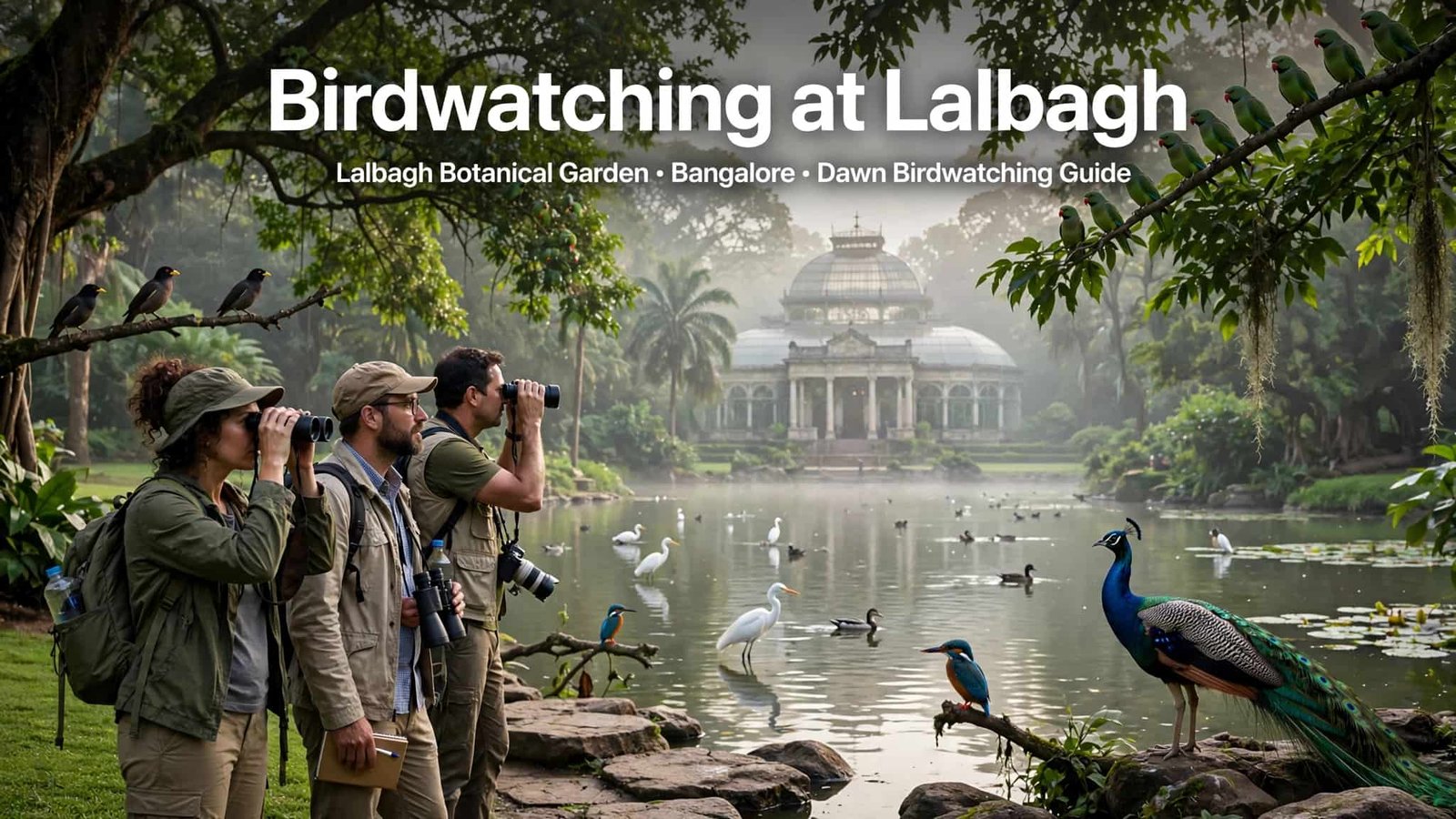
Lalbagh Botanical Garden is best known for its historic landscape, enormous trees, plant collections and the iconic Glass House, but it is also an interesting place to observe urban birdlife.
Spread across about 240 acres in the heart of Bengaluru, Lalbagh contains a mixture of mature trees, landscaped gardens, water bodies, shrubs and quieter green spaces. This variety creates different habitats where birds can feed, rest, call and, in some cases, nest. The Ministry of Tourism also describes Lalbagh as home to bird species including mynas, egrets, parakeets and pond herons.
For visitors, one of the best things about birdwatching here is that you do not necessarily need specialist equipment. A slow walk, some patience and careful observation can reveal birds that are easy to miss while simply walking through the garden.
What Birds Can You See at Lalbagh?
The birds you encounter can vary with season, weather, water conditions and the amount of activity in different parts of the garden. A birdwatching outing documented at Lalbagh recorded 24 species, including waterbirds, raptors, parrots, barbets, bulbuls, sunbirds and other common garden birds.
Some birds that have been documented at or around Lalbagh include:
| Bird | Where You May Look |
|---|---|
| Little Grebe | Lake and other wet areas |
| Great Cormorant | Lake |
| Little Cormorant | Lake and water edges |
| Darter | Lake |
| Little Egret | Shallow water and lake edges |
| Indian Pond Heron | Water edges |
| Spot-billed Duck | Lake |
| Black Kite | Open sky and tall trees |
| Brahminy Kite | Open sky and mature trees |
| Shikra | Trees and woodland areas |
| Rose-ringed Parakeet | Large trees |
| Asian Koel | Tree canopy |
| Spotted Owlet | Tree cavities and mature trees |
| Coppersmith Barbet | Mature trees |
| White-cheeked Barbet | Tree canopy |
| Ashy Drongo | Trees and open areas |
| Common Myna | Open lawns and gardens |
| Red-whiskered Bulbul | Shrubs and vegetation |
| Common Tailorbird | Dense shrubs |
| Tickell’s Flowerpecker | Flowering trees and vegetation |
| Purple-rumped Sunbird | Flowers and foliage |
This should be treated as a representative list rather than a guaranteed checklist for every visit. Bird sightings naturally change over time.
Recent citizen-science records also include species such as Rose-ringed Parakeet and Spotted Owlet in the wider Lalbagh/Mavalli area.
1. Lalbagh Lake – One of the Best Places to Start

If your main goal is birdwatching, Lalbagh Lake is one of the first areas worth exploring.
The combination of open water, shoreline vegetation, rocks and surrounding trees provides habitat for several types of birds. Historical birdwatching observations at Lalbagh recorded Little Grebe, Great Cormorant, Little Cormorant, Darter, Little Egret, Indian Pond Heron and Spot-billed Duck around the water.
Look carefully around the lake rather than only scanning the middle of the water. Birds may be:
- Standing along the shoreline
- Sitting on rocks
- Swimming on open water
- Flying over the lake
- Resting in nearby trees
- Moving through vegetation close to the water
Cormorants can sometimes be seen perched with their wings spread, while herons may stand almost motionless near the water’s edge.
Birdwatching tip: Walk slowly and stop at several viewpoints instead of continuously walking around the lake. Staying still for a few minutes often makes it easier to notice birds.
2. Mature Trees and Woodland Areas

Lalbagh’s mature trees are important to its character and also create useful habitat for tree-dwelling birds.
The garden contains trees that are more than a century old, according to Incredible India, along with a large diversity of plant life.
When walking through these areas, don’t concentrate only on ground level. Scan:
- Tree trunks
- Large branches
- Tree cavities
- High canopies
- Flowering branches
- Fruit-bearing trees
Parakeets, barbets, koels, drongos and other canopy birds can be difficult to spot at first because they may remain high above the paths.
Tree cavities can also be worth checking from a respectful distance. Spotted Owlets have been recorded in the Lalbagh/Mavalli area, and photographs from Lalbagh have documented owls using tree cavities.
3. Flowering Plants and Shrubbery
Lalbagh isn’t only about huge trees. Its extensive plant collections create smaller habitats that can attract birds looking for insects, nectar, seeds and fruit.
Small birds such as sunbirds, flowerpeckers and tailorbirds can be easier to find around flowering plants and dense vegetation.
The Purple-rumped Sunbird and Tickell’s Flowerpecker, for example, were among the species recorded during a Lalbagh birdwatching outing.
When exploring these areas, listen for movement among the leaves. Small birds may be much easier to hear than see.
4. Open Lawns and Garden Paths
Open areas provide a different birdwatching experience.
Common mynas, doves, pigeons and other adaptable urban birds can often be found around lawns, pathways and open garden spaces. Birds may use these areas to search for food or move between different sections of the garden.
The advantage of open lawns is that birds can sometimes be easier to observe against a relatively clear background.
Instead of walking directly toward a bird, stop several metres away and observe it. Sudden movement can cause birds to fly away before you get a good look.
5. The Areas Around the Glass House

The area surrounding the famous Glass House is another place where casual birdwatchers can keep an eye out for birds.
It is not necessarily a dedicated bird sanctuary or bird hide, but the surrounding gardens, mature vegetation and trees provide opportunities for spotting common garden birds.
Because the Glass House area can become busy, particularly during major flower shows, it can be more productive to explore quieter paths nearby if birdwatching is your main objective.
Best Time for Birdwatching at Lalbagh
Early morning is generally the best time to start birdwatching at Lalbagh.
Bird activity can be easier to observe before the garden becomes busy, and morning conditions are usually more comfortable for walking.
A practical birdwatching window is:
Early morning → walk around the lake → explore mature trees → check flowering plants and quieter paths.
An early visit also gives you better opportunities to hear bird calls before visitor noise increases.
Late afternoon can also be worthwhile, particularly for general nature observation, although the exact bird activity will vary by season and weather.
Why Lalbagh Has So Many Different Bird Habitats
One reason Lalbagh is interesting for birdwatching is its habitat variety.
Instead of being one uniform green space, the garden combines:
Water habitat
The lake provides open water and shoreline habitat for birds such as grebes, cormorants, darters, egrets and pond herons.
Mature tree habitat
Large trees provide perching, feeding and shelter opportunities for species such as parakeets, barbets, koels and drongos.
Shrub and understory habitat
Dense vegetation can provide cover for smaller birds such as tailorbirds and bulbuls.
Flowering vegetation
Flowers can attract nectar-feeding birds including sunbirds, while insects around plants provide food for insect-eating species.
Open garden habitat
Lawns and open paths are suitable for adaptable urban birds such as mynas, doves and pigeons.
This combination makes Lalbagh more than simply a landscaped garden—it functions as an important green space for urban biodiversity.
Birdwatching Tips for First-Time Visitors
You don’t need expensive equipment to enjoy birdwatching at Lalbagh. A few simple habits can make the experience much better.
1. Carry binoculars if you have them
Binoculars are especially useful for birds high in trees or on the opposite side of the lake.
2. Start early
Morning is generally more comfortable and can provide good opportunities to hear and observe birds before visitor activity increases.
3. Listen before looking
Bird calls can help you locate birds hidden inside foliage.
4. Look at different heights
Don’t just scan the ground. Check:
- Ground level
- Shrubs
- Tree trunks
- Lower branches
- Upper canopy
- Sky above the garden
5. Move slowly
Fast movement can disturb birds. Walk quietly and stop regularly.
6. Don’t chase birds for photographs
A long-lens camera is useful, but getting a photograph should not come at the expense of disturbing wildlife.
7. Never feed the birds
Feeding can alter natural behaviour and may create problems for wildlife and visitors.
8. Respect restricted areas
Stay on permitted paths and follow garden rules, especially around water, planted areas and protected sections.
Bird Photography at Lalbagh
Lalbagh can also be an enjoyable location for bird photography.
The lake provides opportunities for photographing waterbirds, while the mature trees and flowering plants can provide natural backgrounds for smaller birds.
For better photographs:
- Visit during softer morning light.
- Carry a telephoto lens if available.
- Keep your distance.
- Avoid chasing birds between trees.
- Use natural perches rather than disturbing vegetation.
- Be patient.
A phone camera can still be useful for recording sightings, but small birds high in the canopy may require binoculars or a longer camera lens.
A Simple Birdwatching Route at Lalbagh
If you have around 1–2 hours, you can structure your visit like this:
Start → Lalbagh Lake → lake edges → mature tree areas → flowering gardens → quieter paths → return toward the main attractions
Spend several minutes at each location instead of trying to cover the entire garden quickly.
If you are particularly interested in waterbirds, give more time to the lake. If you prefer smaller songbirds, spend more time around trees, flowering plants and shrubbery.
How Many Bird Species Are Found at Lalbagh?
There isn’t one fixed number that represents every bird species you can expect to see at Lalbagh today.
Historical observations and birdwatching records show considerable diversity. One long-running local birding account estimated that the cumulative number of species recorded at Lalbagh since the 1970s could be around 140–170, while noting that the regularly occurring species over a more recent five-year period were much fewer.
That distinction is important: a historical species record does not mean all of those birds are present on every visit.
For visitors, the more useful approach is to treat Lalbagh as a place where common resident birds can be observed regularly, while seasonal or less frequent species may require more luck and repeated visits.
Is Lalbagh Good for Birdwatching?
Yes, Lalbagh can be a rewarding place for casual birdwatching and urban nature observation, particularly if you enjoy combining birding with a garden walk.
Its lake, mature trees, flowering plants, shrubs and open spaces create a range of habitats within a relatively compact area. Documented birdwatching outings have recorded everything from waterbirds and raptors to parrots, barbets, bulbuls and sunbirds.
You don’t need to be an experienced birder. Even beginners can start by identifying a few familiar species and gradually learning to recognize bird calls, shapes and feeding behaviour.
The key is to slow down.
Instead of simply walking through Lalbagh and looking at the flowers, stop occasionally, listen to the trees and watch the lake. You may discover that the garden has considerably more birdlife than first appears.
Frequently Asked Questions
What birds can I see at Lalbagh?
Depending on the season and conditions, you may encounter birds such as parakeets, mynas, pond herons, egrets, cormorants, bulbuls, barbets, sunbirds, flowerpeckers, kites and owls. Documented Lalbagh observations include 24 species from a single birdwatching outing.
What is the best place for birdwatching in Lalbagh?
Lalbagh Lake is a useful starting point, particularly for waterbirds. Mature tree areas and quieter vegetation are also worth exploring for canopy and smaller birds.
What is the best time for birdwatching at Lalbagh?
Early morning is generally the most suitable time because bird activity can be easier to observe and visitor activity is usually lower.
Do I need binoculars for birdwatching at Lalbagh?
No. Binoculars are helpful, particularly for distant or high-canopy birds, but you can enjoy casual birdwatching with your eyes and a smartphone.
Can I photograph birds at Lalbagh?
Yes, bird photography can be part of a visit. Maintain a respectful distance, avoid chasing birds and follow the garden’s rules.
Is Lalbagh suitable for beginner birdwatchers?
Yes. The variety of habitats and relatively accessible walking routes make it possible for beginners to start with common species and gradually learn identification.
Final Thoughts
Birdwatching at Lalbagh is an easy way to experience Bengaluru’s urban biodiversity. The lake attracts waterbirds, mature trees support canopy species, flowering plants provide food for smaller birds, and open gardens accommodate familiar urban species.
For the best experience, arrive early, carry binoculars if you have them, walk slowly and spend time observing rather than simply moving from one attraction to another.
You may come to Lalbagh for its plants and historic landmarks—but if you pause and listen, the birds can become one of the most memorable parts of the visit.
Read Also: Rare & Exotic Plants at Lalbagh: Notable Species & Botanical Collection

Suresh Kumar is the founder and editor of LalbaghBotanicalGarden.com, a website dedicated to helping visitors plan their trips to Lalbagh Botanical Garden with accurate, well-researched information on timings, fees, history, and attractions. Content is compiled and fact-checked using official sources and government tourism records.
Email: lalbaghgardenbangalore@gmail.com